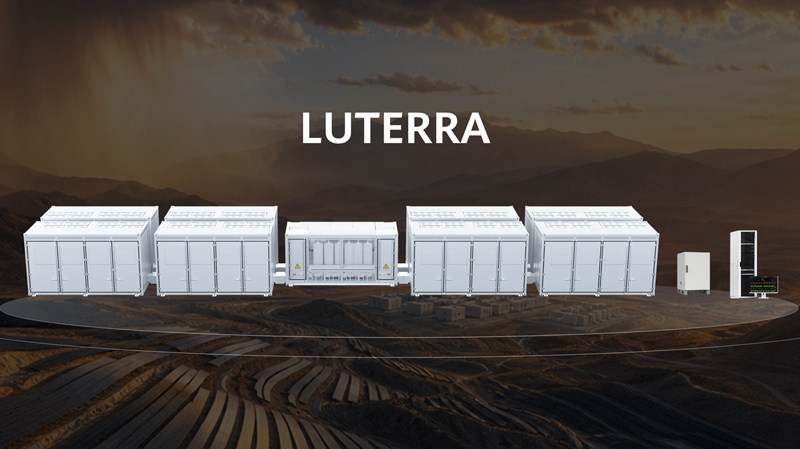
Huawei's Digital Power arm has launched LUTERRA, a rebranded and re-engineered follow-up to its LUNA battery storage line, and it is pitching the platform squarely at the grid-forming era that AI data centres and record renewable penetration are demanding.
What LUTERRA actually is
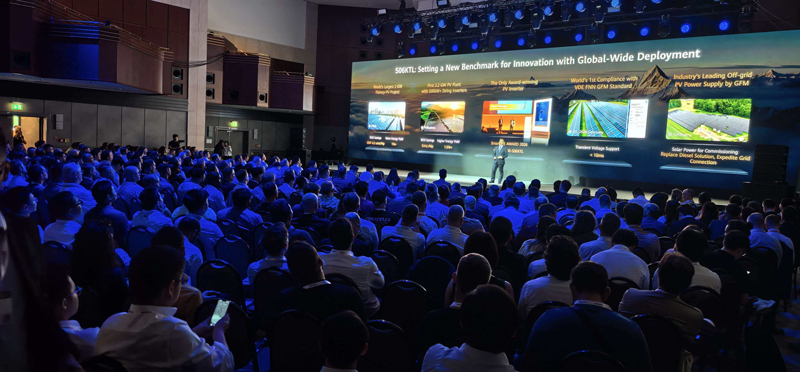
Unveiled during Intersolar Europe 2026 in Munich and detailed in the Chinese giant's July global rollout, LUTERRA is the industry's first Smart String Grid-Forming ESS built around a 1000 Vac string architecture. It maxes out at 12.5 MW / 50 MWh per array, uses Huawei's own 1000 Vac SiC power modules, a through-busbar mechanical design that Huawei says cuts installation time and land, and a smart distributed cooling stack that doubles heat-dissipation area while cutting fan noise about 40 percent.
Grid-forming at plant scale
The differentiator is plant-level grid forming: LUTERRA can synchronously grid-form across tens of millions of devices and self-adapt to shifting grid strength. That unlocks the six grid services regulators increasingly demand — short-circuit level, wideband oscillation damping, inertia response, primary frequency regulation, black start, and on/off-grid switching — from a battery plant instead of a spinning generator.
Investment case for developers
Huawei says a 1 GWh LUTERRA plant delivers roughly 30 percent faster construction-to-commissioning and cuts balance-of-plant costs — land, cables, labour — by more than 20 percent compared with conventional container-based BESS. Over a 20-year lifecycle at an 11¢/kWh spread, the company projects an extra 5.48¢/Wh of returns versus incumbent solutions on a 12.5 MW / 50 MWh reference plant.
Riding the grid-forming wave
LUTERRA lands as grid-forming inverters go mainstream: Firmus locked in 600 MW with Gunvor to underwrite 1.5 GWh of BESS in South Australia, and Neoen won Ontario's 200 MW / 1,600 MWh Dryden contract in the same week. Huawei is also pre-launching a residential LUTERRA S2 unit aimed at retrofitting its 4.3 million-home global PV fleet.
Reporting based on coverage from Huawei FusionSolar, PR Newswire, Best Magazine and Energy-Storage.News.