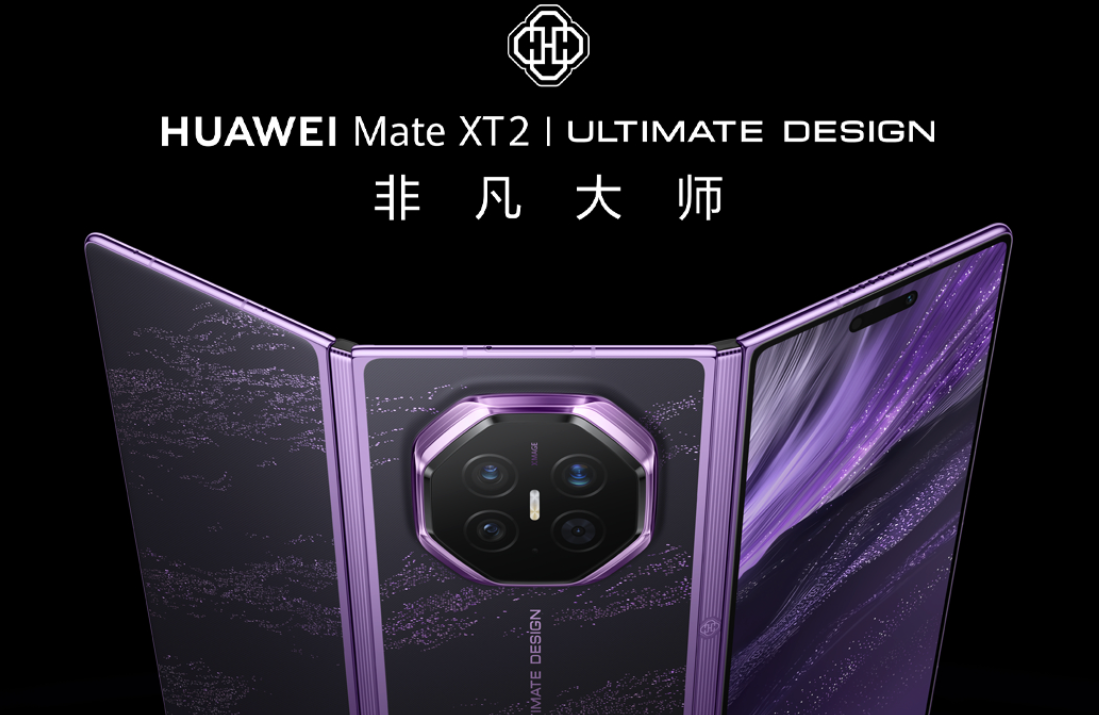
Huawei used a Guangzhou keynote to unveil the Mate XT 2 triple-fold smartphone on September 7, 2026 and the Kirin 9050 Pro chip that powers it — the first commercial silicon built on the company's Tau scaling law and 3D-stacked LogicFolding packaging. Sales open September 12 at RMB 19,999 (roughly $2,800), landing days before Apple's own foldable iPhone debut.
LogicFolding, in production
Huawei first teased its LogicFolding research in May, arguing it could partially compensate for the loss of leading-edge EUV access. The Kirin 9050 Pro is the first Kirin to ship the technique commercially: logic is stacked vertically across multiple layers to shorten signal paths and lift performance without a new process node. Huawei says the chip is 42% faster than the Kirin in the original Mate XTs — 24% higher on single-core and 52% higher on multi-core CPU workloads — with a Maleoon GPU that supports up to 50 million hardware-accelerated rays per second and improved energy efficiency.

Mate XT 2: 10.2-inch trifold, HarmonyOS 7
The Mate XT 2 keeps the double-hinge trifold form factor Huawei pioneered in 2024 but opens into a 10.2-inch tablet-class display and runs HarmonyOS 7, Huawei's fully in-house OS stack. Kirin 9050 Pro handles on-device AI workloads alongside a Huawei-designed CPU, GPU, NPU and 5G modem in a single package, and the device carries Huawei's own imaging pipeline rather than any US-origin components — a hardware-sovereignty statement first and a consumer phone second.
A foldable race with Apple, on Huawei's terms
Timing matters. The RMB 19,999 starting price undercuts the trifold segment Huawei effectively created, and the launch window puts pressure on Apple's foldable iPhone Duo and Siri AI reveal at Cupertino on September 9. Huawei is signaling that its 5G, AI compute and packaging roadmap can advance without direct dependence on the leading US-aligned foundries — a message reinforced by its sovereign-AI partnerships in Brazil and its earlier China optical-interconnect standard with Baidu.
What to watch next
The Kirin 9050 Pro proves LogicFolding works in a mass-market SoC; the question is whether Huawei can scale the technique to laptop and datacenter parts — where the gap with TSMC's 2 nm process matters most. Analysts also expect a broader Mate 80 rollout later this quarter and a Maleoon GPU family expansion in early 2027.
Reporting based on coverage from TechNode, KrASIA, TelecomLead and TIME News.