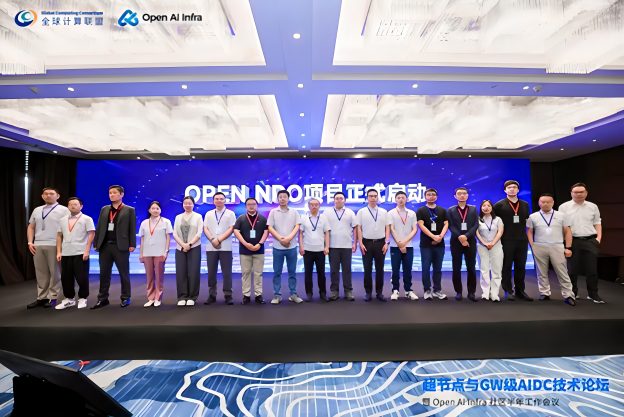
Huawei and Baidu on July 9 anchored the launch of OPEN NPO, China's first Multi-Source Agreement (MSA) for near-packaged optics (NPO), at the Supernode and GW-Level AIDC Technology Forum in Beijing. The MSA was disclosed by TrendForce on July 14 and is designed to give Chinese hyperscalers a unified, open standard for the next generation of AI-cluster optical interconnect.
Twenty-Plus Signatories, One Standard
Along with Huawei and Baidu, the MSA is backed by China Mobile Research Institute, JD Cloud, China Electronics Standardization Institute, ZTE Software, H3C, Accelink, Ligent, HGTech, Lightelligence, Hero Power, Yamaichi, Hirose, Molex, Luxshare Technology, Qinghong Electronics, Aluksen (Westlake University Optoelectronics Research Institute), iNano and Joywell Semi. The consortium formalized under the Open AI Infra Community with backing from the Global Computing Consortium.
Why NPO — And Why Now
Near-packaged optics move the optical engine off the switch faceplate and onto the PCB near the switching or compute silicon, keeping the optics and ASIC in separate packages connected by short high-speed electrical traces. That trims transmission distance and power versus pluggables while preserving modularity, repairability and multi-vendor sourcing — the tradeoffs that fully-integrated co-packaged optics (CPO) still struggle with. TrendForce notes Alibaba and Tencent have already labeled NPO a key technology direction, while Meta, Microsoft and Amazon are pushing similar open efforts abroad through OCI-MSA.

Roadmap Points At Late-2026 Specs, 2027 Adoption
Under the roadmap disclosed by Huawei Computing, OPEN NPO plans to release its first technical specification in Q3 2026, complete product adaptation and full-scenario testing for NPO transceivers and electrical connectors, then broaden the ecosystem in H1 2027 for large-scale commercial adoption. Alongside recent moves such as the SK Group-NVIDIA $500B AI factory and the NAVER-NVIDIA Korea AI factory, the MSA signals just how much of the AI buildout race now hinges on interconnect, not compute silicon alone.
Reporting based on coverage from TrendForce, Huawei Computing and LightReading.