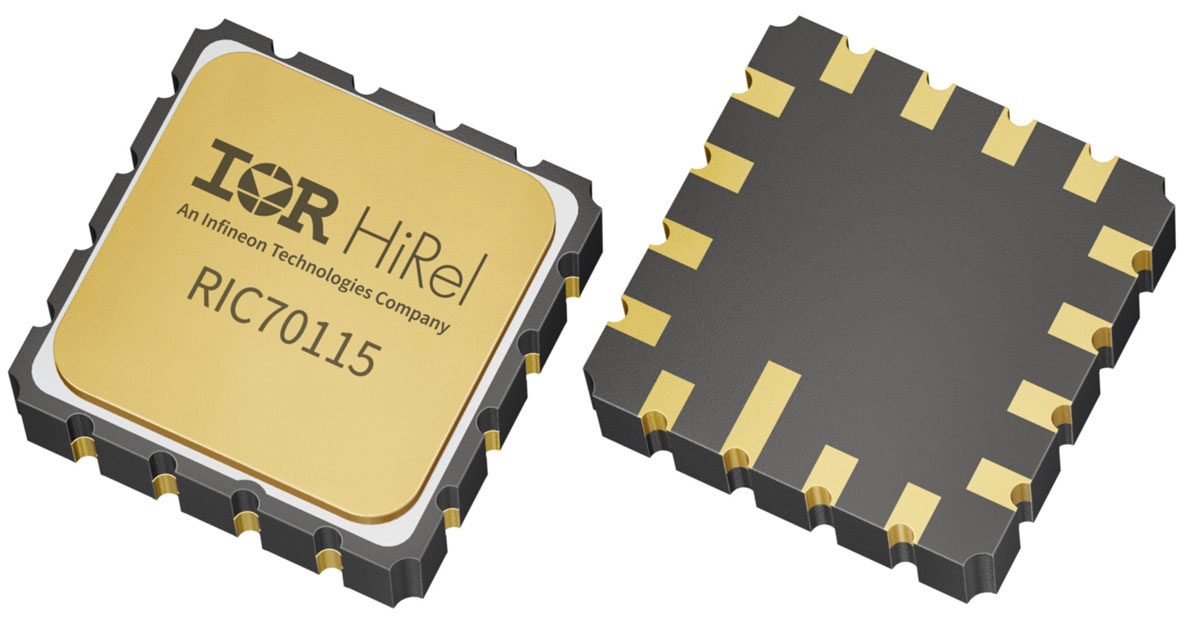
Munich-based Infineon Technologies has introduced the RIC70115, a radiation-hardened gallium nitride (GaN) high-electron-mobility transistor (HEMT) driver aimed at satellite and high-reliability space applications where power-conversion efficiency and long-term operational integrity are non-negotiable.
Silicon-to-GaN Transition For The New Space Economy
The RIC70115 supports both silicon and GaN MOSFET designs in low-side and high-side configurations, giving power-system designers greater flexibility to adopt GaN-based architectures on space platforms without compromising safe operation across varying bias-voltage conditions.
"GaN power solutions are becoming an integral part of the design ecosystem for new space applications, and the pace of adoption is accelerating," said Mike Mills, senior VP and general manager of HiRel at Infineon. "The RIC70115 reflects Infineon's commitment to delivering the integration, performance and radiation hardness that space power designers need to move to GaN-based systems with confidence."
Integrated Miller Clamp, TDI Logic And 4.8 V LDO
The driver integrates an independent Miller clamp to prevent parasitic-induced turn-on while preserving switching speed, cutting switching losses and improving efficiency. A truly differential input (TDI) logic stage rejects common-mode noise and mitigates the electromagnetic and RF interference typical of a satellite power bus.

An integrated low-dropout regulator (LDO) generates a tightly regulated 4.8 V drive voltage from a 5 V or 12 V source, supporting a 4.75 V to 15 V input range and reducing external component count.
Qualified For LEO And Beyond
The RIC70115 meets MIL-PRF-38535 across a -55°C to 125°C operating range. Infineon rates it to a total ionizing dose (TID) of up to 100 krad(Si) and has characterized it for single event effects (SEE) up to a linear energy transfer of 81.9 MeV cm²/mg, providing performance margins required for low-Earth orbit and beyond. The driver ships alongside the RIC70115EVAL1 evaluation board.
The launch follows a run of space-grade component moves this month, including Space Force's $17B NSSL Phase 3 Lane 1 awards and Rocket Lab's LOXSat cryogenic-depot mission with NASA, underscoring rising demand for hardened power electronics.
Reporting based on coverage from Semiconductor Today and Infineon.