IonQ has shown that classical decoding will not be the bottleneck of its fault-tolerant quantum computing roadmap. On August 27, 2026, IonQ researchers Min Ye, Andrii Maksymov and Nicolas Delfosse published an arXiv preprint (arXiv:2608.25027) detailing an end-to-end real-time Quantum Error Correction (QEC) decoding pipeline that ran MegaQuOp-scale workloads – up to 408 logical qubits and more than 1 million T gates – on a single off-the-shelf Apple M4 Max CPU using only 12 cores.
Why real-time decoding is the wall
As quantum processors execute millions of operations across logical qubits (a MegaQuOp), syndrome data has to be decoded as fast as it is produced or the machine slows to a crawl under a decoding backlog. Prior demonstrations relied on custom FPGAs, GPUs or ASICs, and often only for a single memory block. IonQ’s work extends that to a full stack running on commodity silicon.
How the decoder works
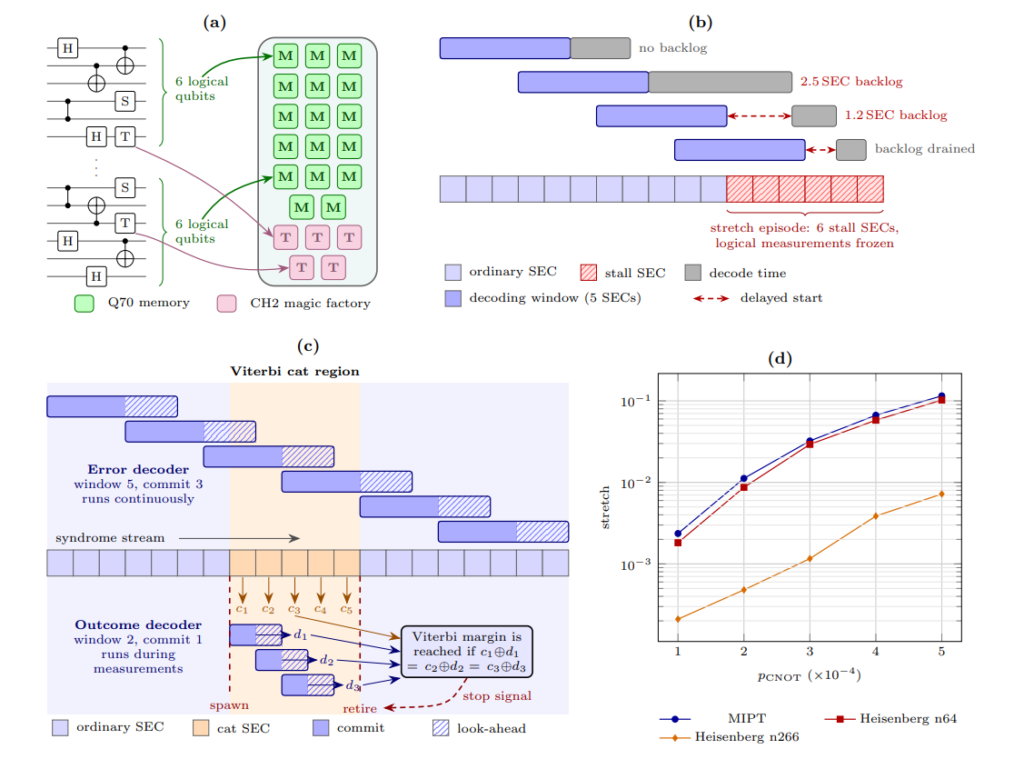
The pipeline pairs two sliding-window decoders running concurrently. A 5-cycle continuous Error Decoder tracks Pauli frames to suppress long-term logical errors, while a 2-cycle low-latency Outcome Decoder resolves Viterbi stopping conditions and error-detected measurement checks during logical measurements. Detector error models are updated on the fly by reusing a fixed Tanner graph and refreshing only the probability priors. Log-likelihood ratios are stored per error node instead of per Tanner-graph edge, cutting memory traffic by more than an order of magnitude.
Benchmarks and the WCA roadmap
The team tested three fault-tolerant circuits compiled for IonQ’s Walking Cat Architecture: a Measurement-Induced Phase Transition workload (102 logical qubits, 1.08M T gates), and Disordered Heisenberg Model runs at n64 and n266 – the latter using 408 logical qubits, 555k T gates and 1.31M logical measurements spread over 88 code blocks and 11,680 physical qubits. At syndrome-extraction cycle times typical of trapped-ion hardware (1–5 ms) and a physical error rate of pCNOT = 10-4, the decoder held computational stretch below 0.3% across all workloads, and stayed under 12% even under elevated noise at pCNOT = 5 × 10⁻⁴.
Where it lands in the wider race
The demonstration lands in the middle of a busy stretch for quantum. It builds on IonQ’s Walking Cat Architecture roadmap and complements recent moves such as Pasqal’s Nasdaq debut after its $360M SPAC, NSF’s $290M funding for eight Quantum Leap Institutes and Brookhaven and Stony Brook’s first U.S. free-space quantum link. It also arrives days after NASA’s $20M Infleqtion award, underscoring how classical hardware and software are quietly becoming as important to quantum scale-up as the qubits themselves.
Reporting based on the arXiv preprint 2608.25027 and coverage from Quantum Computing Report.