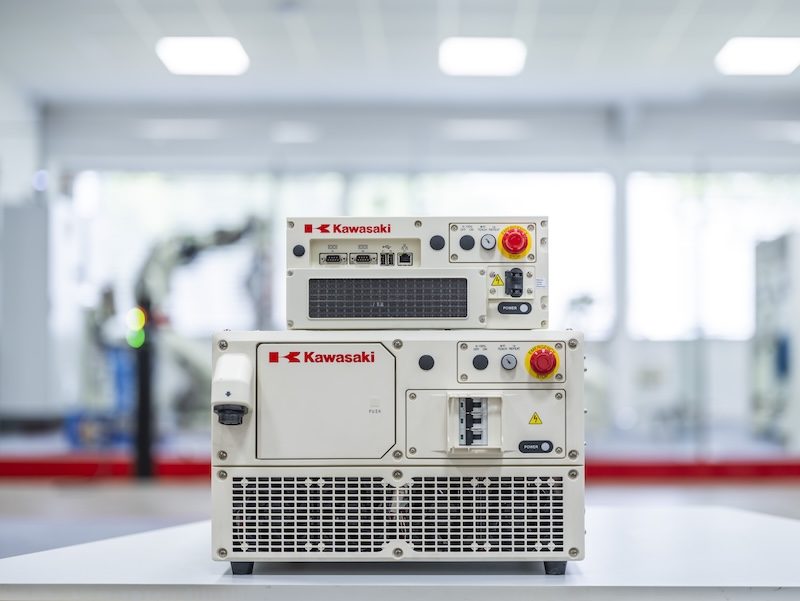
Kawasaki Robotics has launched the F Series Controller S-type, a new industrial robot controller that bundles integrated safety software with certified cybersecurity functions, the company said November 18, 2026. The controller is built to help manufacturers meet the EU Machinery Regulation, which takes effect January 20, 2027, and the Cyber Resilience Act's main product requirements, which land December 11, 2027.
Key takeaways
- The S-type controller ships with CoreCubic-S Lite safety software as standard, assessed by TÜV SÜD against ISO 10218-1:2025.
- Cybersecurity features include user authentication, access management, secure communications and startup integrity checks, with development processes certified to IEC 62443-4-1:2018.
- Existing F Series B-type controllers can upgrade to S-type without replacing hardware, protecting prior customer investment.
- An optional energy recovery feature can cut robot energy consumption by up to 30%.
- The controller arrives ahead of the EU Machinery Regulation (January 20, 2027) and the Cyber Resilience Act (December 11, 2027).
Out of the box, CoreCubic-S Lite monitors one robot tool and one workspace, with additional safety zones and functions available as hardware or software upgrades for customers with more complex cells. Kawasaki paired that with cybersecurity functions built to the IEC 62443-4-1:2018 standard governing secure product development, rather than bolting security on after certification, a distinction regulators increasingly scrutinize as industrial robots connect to factory networks.
Why regulation is now a product feature
The EU Machinery Regulation, replacing the decades-old Machinery Directive, requires manufacturers to treat software and cybersecurity as integral to a machine's safety case rather than an afterthought bolted onto compliant hardware. The Cyber Resilience Act adds a second layer, holding manufacturers liable for vulnerabilities across a product's lifecycle. Robot builders selling into Europe now face certification costs on both fronts simultaneously, and Kawasaki's pitch is that resolving them in one controller, rather than stacking third-party safety and security add-ons, lowers integration risk for machine builders.
Shuhei Kuraoka, president of Kawasaki Robotics EMEA, framed the launch around that compliance pressure directly: "Regulatory requirements are evolving, but our customers need solutions that deliver value well beyond compliance." Rivals including ABB, Fanuc and Yaskawa have each rolled out their own safety-rated controller lines in recent years, but Kawasaki's emphasis on a certified secure-development pipeline, rather than safety alone, reflects where the next wave of robot regulation is heading.
What it means for existing customers
The upgrade path matters as much as the new hardware. Machine builders running F Series B-type controllers can move to S-type without swapping out robots or re-engineering cells, preserving existing programming knowledge and compatibility with Kawasaki's neoROSET offline simulation software. That upgrade option, combined with the optional 30% energy-recovery feature, gives Kawasaki a way to sell compliance to customers who already own its hardware rather than only to buyers of new robots, a retention strategy other automation vendors are likely to copy as the EU's deadlines approach.