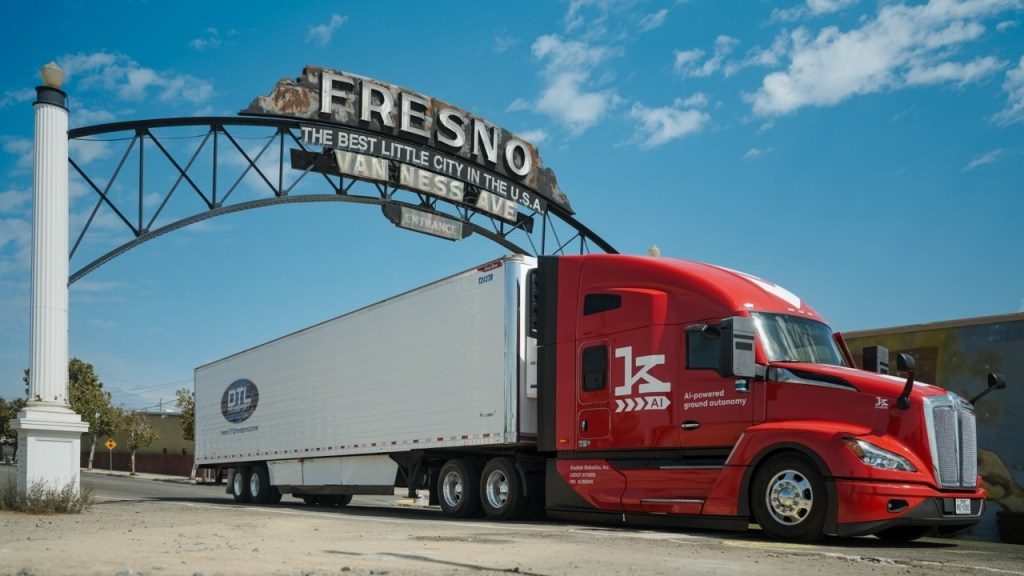
Kodiak AI has signed its first binding commercial contract to run fully driverless trucks on open public highways, agreeing to supply 75 autonomous trucks to California carrier DTL Transport starting in 2028. Every mile Kodiak has driven commercially until now has included a trained safety operator behind the wheel.
What did Kodiak and DTL Transport actually agree to?
DTL Transport, a midmarket carrier that hauls fresh produce and groceries for grocery chains, will own and operate 75 trucks fitted with Kodiak's autonomous driving system. The trucks will run fixed interstate routes, starting with Dallas to El Paso and Interstate 20 between Dallas and Atlanta. Kodiak projects the contract will generate more than $11.2 million in annual recurring revenue once the fleet is fully deployed, based on a licensing fee of roughly $0.97 per mile and an expected 225,000 miles driven per truck each year.
That per-truck revenue, in the range of $150,000 to $190,000 annually, comes entirely from software licensing. DTL Transport owns the hardware and carries the trucking liability; Kodiak just sells the autonomy stack. "We don't want to be in the business of running a trucking company," founder and CEO Don Burnette said of the shift toward licensing.
Why is dropping the safety driver the real headline?
Kodiak has run paid freight for customers including Charger USA, Roehl Transport and Werner Enterprises, but always under a trucking-as-a-service model with a human in the seat. The DTL Transport deal is Kodiak's first driver-as-a-service contract for on-highway operations, meaning the carrier buys the trucks outright and Kodiak licenses the software, with no safety operator built into the business model from day one.
Kodiak says it plans to remove safety operators from a separate, already-running route in December 2026, hauling Ikea goods on Interstate 45 between Dallas and Houston. If that goes smoothly, it becomes the proof point regulators and customers will point to before the DTL Transport trucks hit the road in 2028.
How does this compare to Kodiak's other driverless work?
Kodiak's largest existing driver-out deployment is with Atlas Energy Solutions, which has run 35 driverless trucks hauling sand in West Texas's Permian Basin since 2024 — but that is off-highway, inside oilfield operations rather than on public interstates. The DTL Transport contract is the first time Kodiak has committed to driver-out trucking on open highways shared with ordinary traffic, which is a materially harder regulatory and technical bar to clear.
The timing also matters for Kodiak's balance sheet. The company went public in September 2025, and its stock has fallen roughly 87% from its opening-day price. A binding, revenue-generating contract with a named customer and delivery date gives investors something more concrete than pilot programs to evaluate, even with deliveries still two years out.
What happens next for driverless trucking generally?
Autonomous trucking has been converging on the same playbook industry-wide: start on predictable highway corridors, keep a safety driver until the software proves itself, then license the technology to carriers who already own the trucks rather than trying to run freight operations directly. Separately, the Federal Motor Carrier Safety Administration has approved a five-year exemption letting qualifying Level 4 autonomous trucks use cab-mounted warning beacons instead of traditional roadside warning devices, a small but telling sign regulators are adapting rules written for human drivers.
For Kodiak, the next milestone to watch is December's safety-operator removal on the Dallas-Houston Ikea route. If that holds up without incident, the DTL Transport trucks arriving in 2028 will be the first real test of whether driver-out economics work at highway scale for a carrier that isn't a specialized bulk hauler.