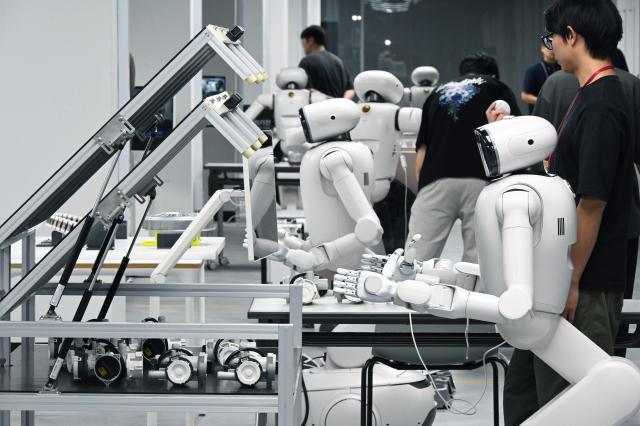
LG Electronics signed a memorandum of understanding on November 13 with the Korea Institute for Robot Industry Advancement (KIRIA) to jointly develop safety, reliability and usability testing systems for humanoid robots. Under the deal, LG will help build testing infrastructure at KIRIA's humanoid robot safety certification center and contribute to national and international standards, while pursuing pilot certification in South Korea for its own robots, including LG CLOiD, according to Aju Business Daily.
The timing isn't incidental. LG is racing toward a first-quarter 2027 unveiling of a bipedal humanoid robot built on Nvidia's Isaac GR00T foundation model and Jetson Thor computing platform, following an August memorandum of understanding between LG Group chairman Koo Kwang-mo and Nvidia CEO Jensen Huang. Before that robot walks into a factory or a home, LG wants a certification body ready to prove it's safe.
Why Certification Is Becoming the Real Bottleneck
Humanoid robots face a harder safety problem than the industrial arms that came before them. A robot welding car doors inside a caged work cell only needs to avoid hitting the cell walls. A humanoid designed to work alongside people — or eventually inside homes — needs to avoid hitting the people themselves, under far less predictable conditions. That gap between controlled-environment robots and human-adjacent robots is exactly what existing safety standards were never built to cover.
LG's CLOiD has already been testing inside that gap: the robot learned a washing machine manufacturing process at LG's Data Factory in August, putting it on a real production line rather than a lab bench. Bringing Korea's robotics standards body into the loop before the bipedal robot's public debut suggests LG wants certification solved early, not bolted on after a safety incident forces the issue.
A Race Where Rules Haven't Caught Up to Robots
LG isn't alone in hitting this wall. In the US, the FDA has been soliciting industry input on how to regulate autonomous surgical robots before writing new rules, and TÜV SÜD has pitched simulated safety checks specifically to cut robot certification timelines by 30%. The pattern is the same everywhere: hardware and AI models are advancing faster than the testing frameworks meant to validate them.
South Korea has reasons to move fast here. The country already leads the world in robot density, and its government has committed $330 million toward building a domestic humanoid parts supply chain aiming for 80% local sourcing by 2030. A credible, KIRIA-backed certification pathway would let Korean manufacturers like LG, Samsung and Hyundai's Boston Dynamics clear regulatory hurdles domestically before competing for safety approval in markets like the US and EU, where standards remain fragmented.
Whether KIRIA's certification center becomes a model other countries adopt — or just a domestic formality — will depend on how rigorous its testing actually proves to be once LG's bipedal robot and competitors' machines start showing up for evaluation. For now, the MoU signals that Korea's biggest electronics maker sees robot safety as something to get ahead of, rather than clean up after.