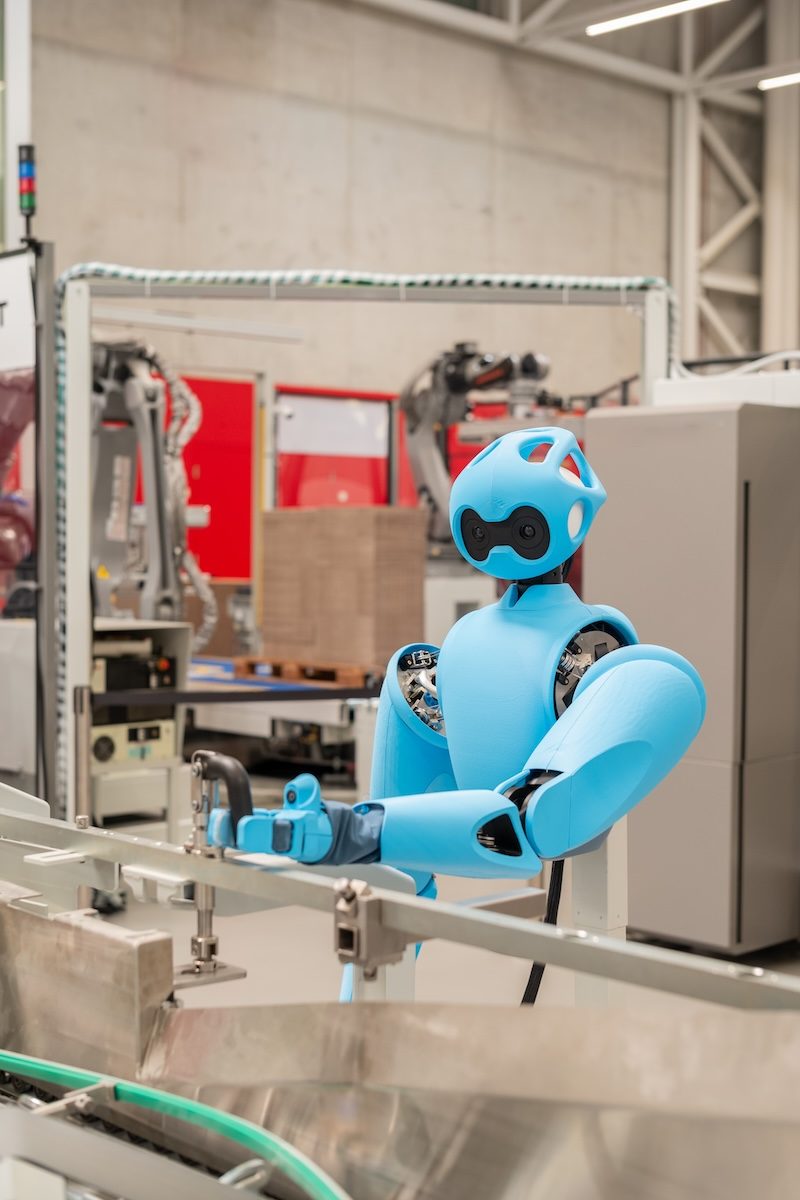
Embodied AI, a Swiss robotics startup founded by three PhDs from EPFL, ETH Zurich and Cambridge, unveiled its first commercial humanoid, AIR, at Humanoid Europe 2026 on November 15. The company says it went from research prototype to a factory-floor machine with signed OEM contracts in nine months, and that AIR already hits 98% reliability on cable-handling tasks running on live production lines.
What makes AIR different from other industrial humanoids?
AIR skips legs entirely. It moves on wheels and uses a tendon-driven architecture, with motors and gearboxes housed in the torso rather than the arms. That keeps the arms light and lets them yield on contact instead of fighting back, which matters on a factory floor where people and machines share the same aisle.
The robot is built to ISO/TS 15066:2016, the standard covering collaborative robots that work without safety cages, and Embodied AI plans CE marking in 2027. Co-founder and CEO Francesco Stella framed the design choice around risk tolerance rather than ambition: "Hallucination of AI models is acceptable in the digital space," he said. "In robotics, however, incorrect actions have immediate and irreversible physical consequences."
How does the robot actually learn a new task?
Instead of training a model offline and deploying it cold, Embodied AI has human operators guide the robot through a task directly on the line. The system is designed to pick up the skill from that hands-on demonstration within roughly a month, after which it runs with less supervision. The company reports 98% reliability on cable-handling, above the 90% threshold it says manufacturers generally require before trusting a task to automation.
That approach is a direct response to a problem that has slowed other humanoid programs: models trained in simulation or on borrowed datasets often stumble when they meet a specific factory's parts, lighting and layout. By learning on the actual line from day one, Embodied AI is betting it can close that gap faster than competitors relying on large, general-purpose foundation models.
Why does this matter beyond one startup's product launch?
The pitch lands at a moment when manufacturers are short-staffed and humanoid robotics has struggled to move from demo reels to repeatable production work. Embodied AI cites projections of as many as 1.9 million unfilled US manufacturing jobs by 2033 as the backdrop for its bet on collaborative, wheel-based humanoids that don't need a redesigned facility to operate.
AIR also arrives as rivals pursue very different paths to the same factory floor. Apptronik's Apollo 2 recently posted 96% accuracy sorting parts on a live Mercedes-Benz line using Google's robotics model, while GXO and Apptronik are planning trials toward a possible 1,000-unit deployment. Chinese manufacturers including AgiBot and UBTech are scaling bipedal humanoids at high unit volumes. Embodied AI's wheeled, tendon-driven, learn-by-doing approach is a narrower bet: faster time-to-deployment on a smaller set of manual tasks, rather than a general-purpose bipedal worker.
What happens next for the company?
Embodied AI's Series A was led by Faber, with TechShop, Look AI Ventures, Plug and Play and Vento also participating; the company has not disclosed the round's size. The near-term plan is to expand the list of signed OEM contracts beyond cable-handling into other manual assembly tasks, while working toward the 2027 CE marking needed to sell AIR more broadly across the European market.