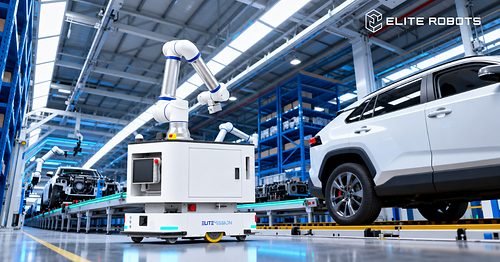
Elite Robots announced on November 16 that its ELITEMISSION mobile manipulator line has achieved CE compliance, clearing the way for broader sales across European factories. The product, developed by Elite subsidiary Mission Robots, pairs a collaborative robotic arm with an autonomous mobile base, letting a single machine move between workstations instead of staying bolted to one spot on a line.
What does the CE certification actually unlock for Elite Robots?
CE marking is the regulatory baseline required to sell industrial equipment inside the European Union and European Economic Area, covering safety, electromagnetic compatibility and machinery directives. Without it, a mobile manipulator combining a moving arm with an autonomous base, a more complex safety case than a stationary robot arm, cannot be legally installed on a European factory floor. Elite says the certification lets it expand mobile automation sales through its existing distributor and systems-integrator network, which already spans more than 50 countries, according to the company's announcement carried by PR Newswire.
What is the ELITEMISSION actually built to do?
The system combines a robotic arm with integrated vision, a mobile navigation platform, and a unified control interface so the arm and base can be programmed and coordinated as one unit rather than two separately engineered systems. Elite positions it for machine tool loading and unloading, component handling, and moving parts between stages of a production line, tasks that traditionally required either a fixed robot arm with a conveyor feeding it, or a human pushing a cart. Target industries named in the announcement are automotive manufacturing, electronics, semiconductors and new-energy production, four sectors where factories are adding flexible automation to handle frequent product changeovers.
Charles Xie, Elite's overseas sales director, said achieving CE compliance for the mobile robot lineup marks a major milestone in the company's global expansion, a framing that signals Elite sees mobile manipulation, not just fixed-arm collaborative robots, as its next growth category.
How does this fit into the broader mobile robotics market, and who competes here?
Elite Robots, founded in Shanghai in 2016, built its business on collaborative robot arms sold worldwide, competing with Universal Robots, Techman Robot and Fanuc's cobot line. Mobile manipulators that combine an arm with a navigating base are a newer, faster-growing category that also includes offerings from Agile Robots, Mobile Industrial Robots and a wave of Chinese manufacturers now pushing into export markets. Forecasts cited alongside logistics robot market data this month put the broader mobile robot sector on track to roughly double in size by 2030, growing from about $6.3 billion in 2025 to over $12 billion, a trajectory that explains why established cobot makers like Elite are racing to add mobility to their existing arm businesses rather than cede the category to newer entrants.
Elite has not disclosed pricing or specific European customers for ELITEMISSION, and the company's announcement did not include unit sales figures or delivery timelines, details that would clarify how quickly the certification translates into actual factory floor deployments.