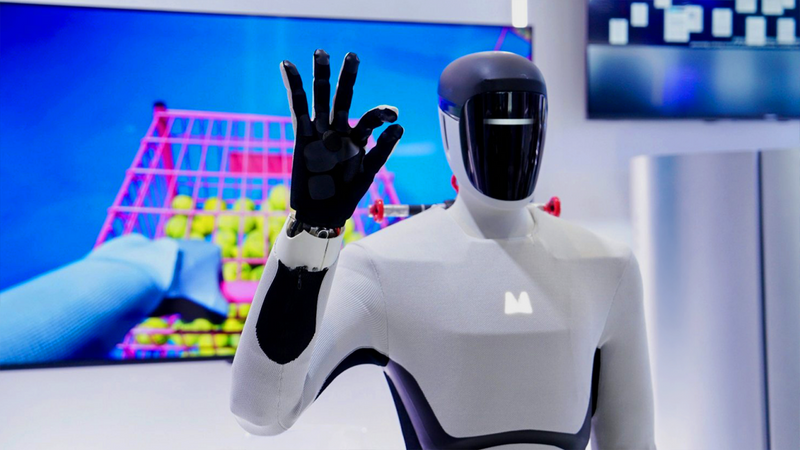
Inside a hall packed with visitors at Shanghai's National Exhibition and Convention Center, a 1.70-meter humanoid robot fielded questions, read the room, and adjusted its explanations on the fly. Matrix Robotics debuted its third-generation humanoid, MATRIX-3, as an autonomous tour guide at the 9th China International Import Expo, which ran November 5-10, with the company announcing the deployment on November 11. It marks the robot's first appearance in an unscripted, real-world public setting rather than a staged demo.
MATRIX-3 weighs 65 kilograms and uses a 27-degree-of-freedom rope-driven hand capable of 0.1-newton fingertip sensing accuracy, according to the company. Its cognitive and motor functions run on what Matrix Robotics calls the WAVE physical world base model, structured as a "brain-cerebellum" system: WAVE handles perception, intent recognition, knowledge retrieval, and dialogue planning, while a separate motion control model manages walking and gesture.
Why scripted demos aren't the real test
Most humanoid robot showcases to date have relied on pre-programmed routines — a wave here, a handshake there, timed to a narrator's cue. Matrix Robotics says MATRIX-3 breaks from that pattern entirely at CIIE, retrieving explanation content dynamically based on who is in front of it and what they're asking, without a human operator feeding it lines. That distinction matters because crowded, noisy exhibition floors are exactly the kind of unpredictable acoustic and visual environment that trips up voice recognition and navigation systems trained in cleaner lab conditions.
The company says each live deployment feeds data back into its training pipeline, a flywheel intended to sharpen voice recognition in noisy settings and dynamic crowd avoidance over successive events rather than through isolated lab updates.
A crowded field of humanoid greeters
MATRIX-3 joins a growing roster of Chinese humanoids seeking public-facing roles as a proving ground before industrial deployment, following UBTECH and Xinhua's news-anchor robots and various hospitality humanoids shown at trade events this year. Service and guide roles are a lower-stakes entry point than factory floors: a tour guide that mishears a question is an inconvenience, while a misjudged grip on an assembly line is a safety incident.
That said, the tour-guide format also exposes real limits. CIIE drew exhibitors from 162 countries across more than 440,000 square meters of floor space, a scale and multilingual mix that stresses natural-language handling far more than a controlled showroom. Matrix Robotics has not disclosed pricing for MATRIX-3 or detailed plans for commercial guide deployments beyond the expo, leaving open whether this debut converts into paid contracts with venues, museums, or retail chains looking for interactive staff.
For now, the company is using CIIE as evidence that its WAVE model can operate outside curated demo conditions — a bar that, judging by how many humanoid launches still rely on choreography, remains surprisingly hard to clear.