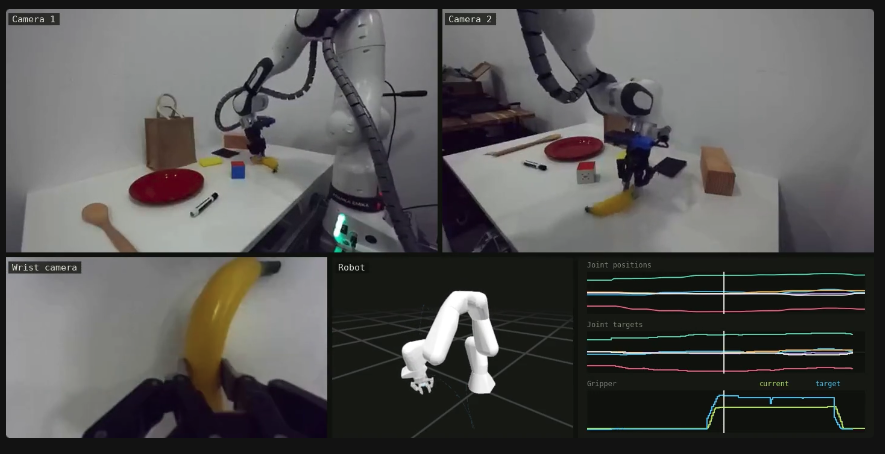
A robot foundation model called FLUX-mimic-x, built by the startup mimic, has posted faster task-completion times than a human operator on a public benchmark that pits AI models against people controlling the same robotic arm. In results published November 26, 2026 on the Physical AI Leaderboard, or PhAIL, FLUX-mimic-x finished manipulation tasks in a median of 11 seconds, compared with 27 seconds for a human teleoperator working the identical Franka FR3 arm. The model logged 3.08 successful tasks per minute against the human's 1.83.
The catch is reliability. The human operator succeeded 94.7 percent of the time, while FLUX-mimic-x succeeded only 71.2 percent of the time. PhAIL is organized by Positronic Robotics in partnership with AI infrastructure firm Nebius, running from October through December 2026, and tests models on tasks like opening drawers, moving household objects and placing items into containers.
Speed Without Reliability Is a Known Trap
The result captures a tension that has defined robot foundation models all year: raw speed is easy to showcase, but speed with a roughly three-in-ten failure rate is not something a warehouse or factory can use unsupervised. A human doing a task correctly 95 percent of the time, even slowly, is still more valuable on a real production line than a model that moves fast but drops the ball nearly 30 percent of the time. For now, FLUX-mimic-x's win is a speed record on a leaderboard, not evidence that AI models are ready to replace teleoperators in production settings.
FLUX-mimic-x works by generating predicted video frames of how objects will move, using Black Forest Labs' FLUX 3 video model as its backbone, and then converting those predictions into robot actions. That video-first approach is becoming a recognizable school of thought in physical AI, distinct from models that reason primarily over language and images.
A Crowded Leaderboard Says the Field Is Converging Fast
FLUX-mimic-x wasn't alone at the top. Runway's Praxis-1 posted a similar median completion time to the human baseline and a 65.7 percent reliability score, while also demonstrating the ability to recover from slipped objects 66 percent of the time. Nvidia's Cosmos3 Nano reached 68.7 percent reliability but a slower 1.24 tasks per minute, and OpenAI's GPT-6 Astra trailed the group at 0.45 tasks per minute. Black Forest Labs' own FLUX 3 Action model scored 63.7 percent reliability.
That spread of results, five serious contenders within a few points of each other on reliability, suggests robot foundation models are now a genuine multi-player race rather than a contest with one obvious leader. Positronic Robotics' decision to keep adding entrants to PhAIL through December gives outside observers a rare, standardized way to compare models that would otherwise only be assessed through each company's own cherry-picked demo reels. For buyers evaluating which physical AI model to license for a pick-and-place line, a leaderboard that reports both speed and reliability, rather than speed alone, is likely to become the more trusted reference point going into 2027.