Muon Space on Wednesday introduced Condor-Ultra, a Starship-class spacecraft platform purpose-built for the emerging orbital data-center market and aimed at hyperscale customers, defense missions and next-generation Earth-sensing constellations.
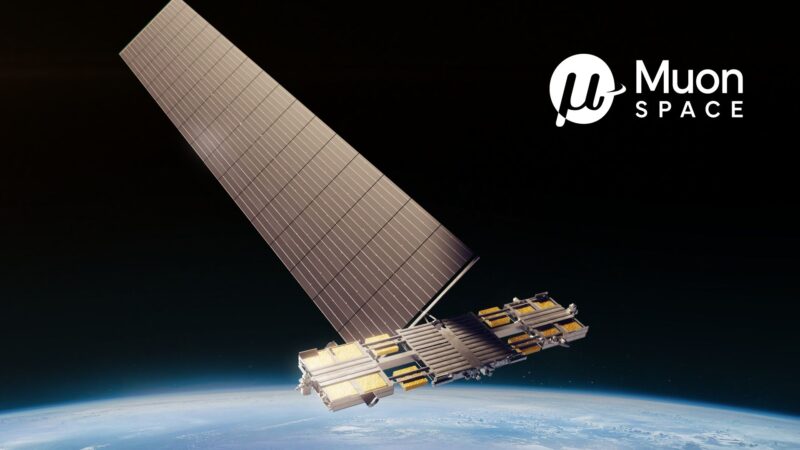
The five-year-old California satellite maker said the first Condor-Ultra pathfinder mission is targeted for 2028, with the bus designed to flat-pack inside SpaceX's Starship payload fairing and stack hundreds of units per launch.
20 kW baseline, scalable to 100 kW
Condor-Ultra is the third member of Muon's Condor family, joining the smaller Condor-M and Condor-XL. It delivers 20 kW of baseline power and more than 18 square meters of nadir payload area, with a scalable architecture that can reach 100 kW — roughly three times the mass and five times the power of Muon's previous flagship.
"The most compelling space-infrastructure missions of the next decade — from global communications networks to scaled remote sensing to distributed orbital compute — require a managed and integrated platform that is powerful, stackable and built to scale cost-effectively," CEO Jonny Dyer said in a statement.
Nvidia inside, Starlink alongside
The platform integrates NVIDIA's newly announced Space-1 Vera Rubin module, the GPU maker's space-hardened inference system, making Muon one of the first manufacturers to publicly commit to that hardware. Muon also confirmed that Condor-Ultra ships with SpaceX's Starlink Mini Lasers for inter-satellite optical mesh networking, providing always-on 25 Gbps ground-to-space connectivity and 100 Gbps satellite-to-satellite links.
That positions Muon directly against companies including Vast, Sierra Space and Cowboy Space — all racing to offer compute-rich satellite buses as AI infrastructure spills off Earth.
Orbital data centers gather steam
The announcement lands as hyperscalers begin formal evaluations of in-orbit compute. SpaceX has filed paperwork for a million-satellite AI data-center megaconstellation, and Space Compass and other operators have unveiled optical relay programs. Muon says it has been working with hyperscalers on operational requirements for orbital compute, though it declined to name customers.
For Muon, Condor-Ultra also broadens its addressable market beyond government Earth observation contracts. The company is increasingly competing in the bus segment dominated by Boeing's Resolute, Lockheed Martin's LM 400 and L3Harris's larger platforms, while staying compatible with medium launch vehicles in case Starship slips.
Why now
Orbital data centers remain unproven — chip lifespan, radiation tolerance and economics are all open questions. But the strategic logic is straightforward: power and cooling are getting expensive on the ground, while solar and vacuum are free in orbit. Coupled with reusable mega-launchers and cheaper inference silicon, the math finally pencils out for a small but growing customer base.
Reporting based on coverage from SpaceNews, Via Satellite, Aviation Week and PR Newswire.