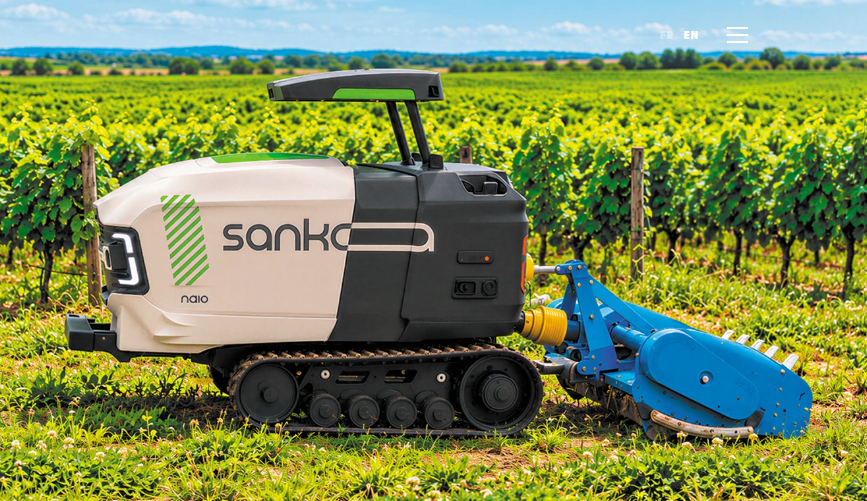
Naïo Technologies gave the world premiere of SANKA, a fully electric, autonomous tracked platform, at EIMA International in Bologna on November 6. Unlike the French company's earlier task-specific robots, SANKA is built to carry up to one tonne of a farmer's existing equipment rather than requiring dedicated robotic attachments.
The 2.2-tonne machine comes in Compact and Large configurations and climbs slopes of up to 30%, navigating fields autonomously using RTK-based positioning. It carries a standard three-point linkage, power take-off, hydraulic connections and electrical interfaces, so growers can hook up the mowers, sprayers or cultivators they already own. A tracked undercarriage developed with tire maker Michelin is meant to improve traction while reducing soil compaction, a chronic problem with heavy farm machinery. Naïo says SANKA has completed four full agricultural seasons of field testing and is now entering pre-series production, with initial customer deliveries planned for the second half of 2027.
A different bet than task-specific robots
Naïo built its reputation on single-purpose robots: OZ for sowing and weeding, TED for straddling vine rows, ORIO as a tool carrier, and JO for narrow vineyard rows. SANKA breaks from that approach by positioning itself as a general-purpose power unit, closer to an autonomous tractor than a dedicated weeding robot. That is a deliberate response to one of the biggest barriers to robot adoption on farms: the cost of buying new, robot-specific implements on top of the robot itself.
By accepting standard three-point hitches and hydraulics, Naïo is betting that farmers will adopt autonomy faster if it works with equipment already sitting in their sheds. It is a similar logic to Naïo's existing partnership with equipment maker KIOTI, which is jointly developing a modular robotic platform, suggesting SANKA may eventually plug into that collaboration too.
Why compatibility matters more than novelty
Agricultural robotics has no shortage of impressive one-off demonstrations, but adoption has lagged because most systems ask farmers to rebuild their toolkit around a single robot. Rivals like startups building dedicated weeding or spraying bots face the same hurdle: strong results in trials, slow uptake once pricing and retooling costs enter the picture.
SANKA's slower rollout, with deliveries not expected until the second half of 2027, reflects how cautiously Naïo is treating that gap between demo and dealership. Four seasons of field testing and a staged pre-series production run suggest the company would rather prove reliability on slopes and varied terrain than rush a general-purpose platform that fails in the one scenario a task-specific robot was never asked to handle.