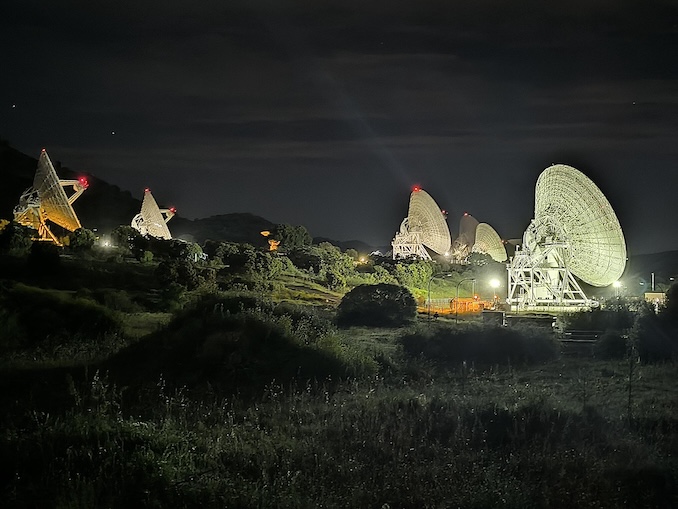
NASA evacuated the Madrid Deep Space Communications Complex on Friday, July 24, 2026, as wildfires burned through the hills west of the Spanish capital. All 90 personnel at the Robledo de Chavela site were safely evacuated and mission operations were seamlessly transitioned to the Goldstone Deep Space Communications Complex in California.
Fire passes through Robledo de Chavela
The wildfire has passed through the MDSCC compound, NASA said in a statement, and damage will be assessed once it is safe to re-enter the area. The Madrid station is one of three geographically distributed ground complexes — with Goldstone in California and Canberra in Australia — that provide 24/7 coverage of deep-space missions, using 230-foot (70 m) antennas that weigh roughly 2,970 US tons each.
A stress test for the Deep Space Network
Losing Madrid, even temporarily, is a serious stress test for the DSN. As Voyager 1 continues to drift outward, its Plasma Wave System already requires a five-antenna array to downlink science data; a sixth antenna will eventually be needed. The evacuation follows a September 2025 mishap at Goldstone's DSS-14 antenna, which over-rotated while tracking Juno and sustained an estimated $4.1M–$4.6M in damage. NASA's SCaN office says it is coordinating closely with local Spanish authorities and the US embassy.

Spain's wildfires and broader space-comms strain
Over 25,000 people have been evacuated in Spain this week and more than 20,000 remain in lockdown. Any Madrid downtime lands at an awkward moment for NASA science operations, which are already juggling SpaceX Starship Flight 13 telemetry, this week's MRV/MEP geosynchronous servicing launch and the SDA Golden Dome tracking constellation buildout.
Reporting based on coverage from Spaceflight Now, NASA, BBC News and Space Policy Online.