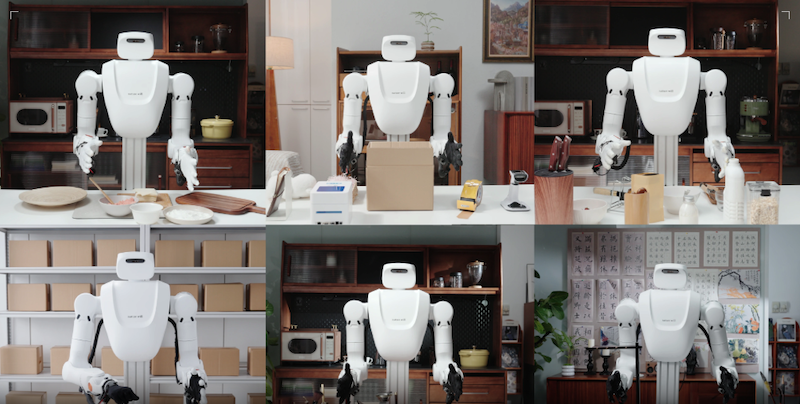
Folding a towel, placing glasses in a case, swapping which hand holds an object mid-task — these are the kinds of fine manipulation that have stumped robots for years, long after they learned to walk and grasp a box. Chinese physical-AI lab Nature Will says it has a new answer: a 50-billion-parameter model, released November 9, trained not primarily on robot data but on roughly a million hours of human video.
The model, called Natura-1, is built as a mixture-of-experts architecture and runs on a 100-millisecond control loop, fast enough to adjust a robot's grip in near real time as an object shifts or a task changes mid-motion, according to Robotics and Automation News. Nature Will trained the model jointly on language, images, video and action data, then adapted it with a smaller amount of real robot data to drive hands with as many as 20 degrees of freedom.
'Natura-1 is a 50-billion-parameter mixture-of-experts model with dexterous manipulation, long-horizon execution, and zero-shot instruction following, making it truly capable of scaling human experience into purposeful action,' said Nature Will CEO Ning Ding.
Learning From People Instead of Robots
The bet behind Natura-1 is one shared by a growing number of physical-AI labs: that the fastest way to teach a robot dexterity is to skip expensive robot teleoperation data collection and instead mine the vastly larger supply of first-person human video. Nature Will describes Natura-1 as trained predominantly on egocentric human footage, with robot-specific data used mainly to bridge the gap between watching a hand move and commanding an actuator to replicate it.
That approach is meant to let the model generalize to instructions it was never explicitly trained on. According to the company, a user can tell Natura-1 to change an object's destination, its orientation, or a physical constraint mid-task, and the model adapts its manipulation plan rather than replaying a fixed script. Nature Will points to tasks like unfolding a towel or repositioning glasses into a case, where contact points shift and the acting hand can change partway through, as examples of the zero-shot generalization it is targeting.
Entering a Crowded Field of Foundation Models
Natura-1 arrives into a field that has filled quickly. Physical Intelligence's pi-series models, Figure's Helix, and a wave of Chinese labs racing to train vision-language-action systems have all pursued some version of the same goal: a single model that can control different robot hardware without retraining for each task. Nature Will has not yet published independent benchmark comparisons against those rivals or disclosed whether Natura-1 will be released as open-source weights, an API, or a licensed product.
What distinguishes Nature Will's pitch is scale of training data rather than robot hardware of its own. The company has not disclosed funding, headquarters location, or a commercial timeline, framing itself instead as 'a physical AI lab dedicated to building physical AGI.' Robot makers building hands with 20 or more degrees of freedom, including several humanoid developers now shipping tactile fingers, represent the most likely early customers for a model pitched as hardware-agnostic. Whether that framing survives contact with real factory floors, where unexpected objects and lighting routinely break models trained primarily on video, is the question rival labs and potential customers will be testing for themselves in the coming months.