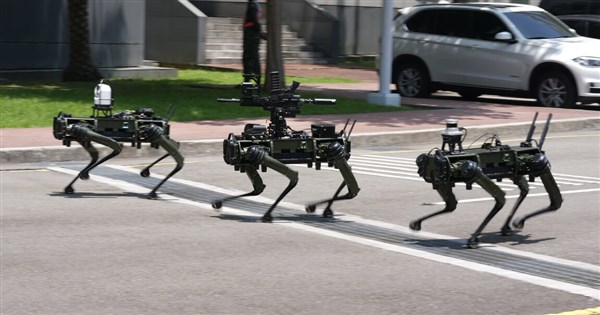
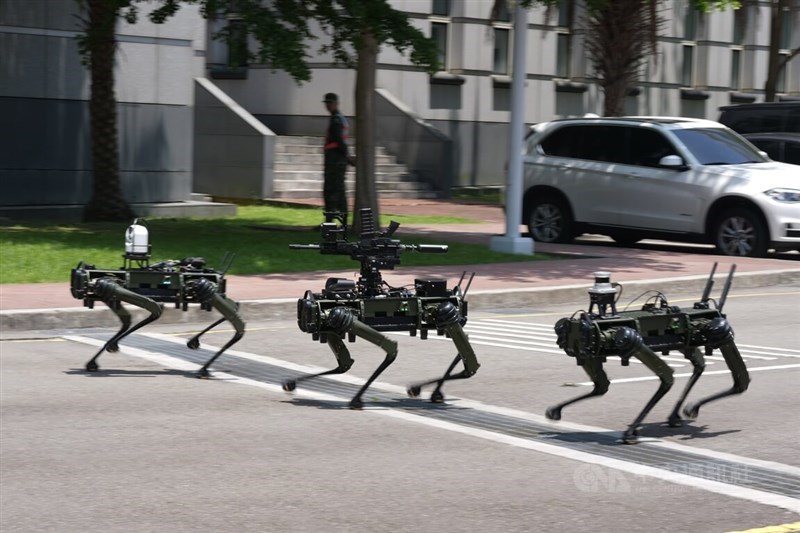
Taiwan's National Chung-Shan Institute of Science and Technology (NCSIST) unveiled three military-grade robot dog prototypes in Taipei on June 2, 2026, all built on the Vision 60 quadruped from U.S. supplier Ghost Robotics and integrated with locally developed sensors, reconnaissance systems and a remote-controlled weapon station. The demonstration is Taiwan's clearest public step yet toward fielding armed unmanned ground vehicles for surveillance, reconnaissance and combat support.
Three Variants For Three Missions
Jen Kuo-kuang, who leads NCSIST's Missile and Rocket Systems Research Division, said the first variant carries LiDAR and a thermal imager for patrol, obstacle avoidance, environmental sensing and 3D mapping. It is aimed at security patrols, facility surveillance and night-time monitoring. The second variant carries an NCSIST-developed electro-optical reconnaissance suite for intelligence, surveillance and target tracking, transmitting data to a smart command and control system. The third variant adds a remote-controlled weapon station, giving it strike capability for coastal defence, airfield security, riot control and urban warfare.
Vision 60 Specs And Networking
The Vision 60 platform weighs about 52.4 kilograms, can carry up to 10 kilograms of payload and runs at up to 2.5 metres per second. NCSIST said it operates between minus 40 and 55 degrees Celsius, holds an IP67 rating against rain, dust and mud, and can self-right after a fall. Endurance runs eight to ten hours. NCSIST said the robots can network with one another to share information and could eventually be integrated with unmanned ground vehicles and drones to form a three-dimensional battlefield mesh.
Taiwan Joins A Crowded Armed Quadruped Race
The unveiling lands as armed quadrupeds spread across multiple militaries. The U.S. Army has cleared its own armed robot dog for special operations evaluation, while Foundation Future Industries won a $24 million Pentagon contract for its Phantom humanoid robot earlier this year. China continues to roll out its own combat quadrupeds. NCSIST framed the deployment as a way to reduce personnel exposure in dangerous battlefield environments. The Ghost Robotics platform is already exported to allied militaries in Europe, the Middle East and Asia, and Taiwan's localisation strategy mirrors how it has integrated foreign components into its naval drones and missile programmes. The launch sits alongside Taiwan's broader defence push that also included an NCSIST drone partnership with a U.S. defence firm announced the next day. Consumer-grade quadrupeds are advancing too, with Beijing's Vbot delivering its first consumer robot dog to Horizon Robotics founder Yu Kai just one day earlier.
Reporting based on coverage from Focus Taiwan, CNA and Defence Blog.