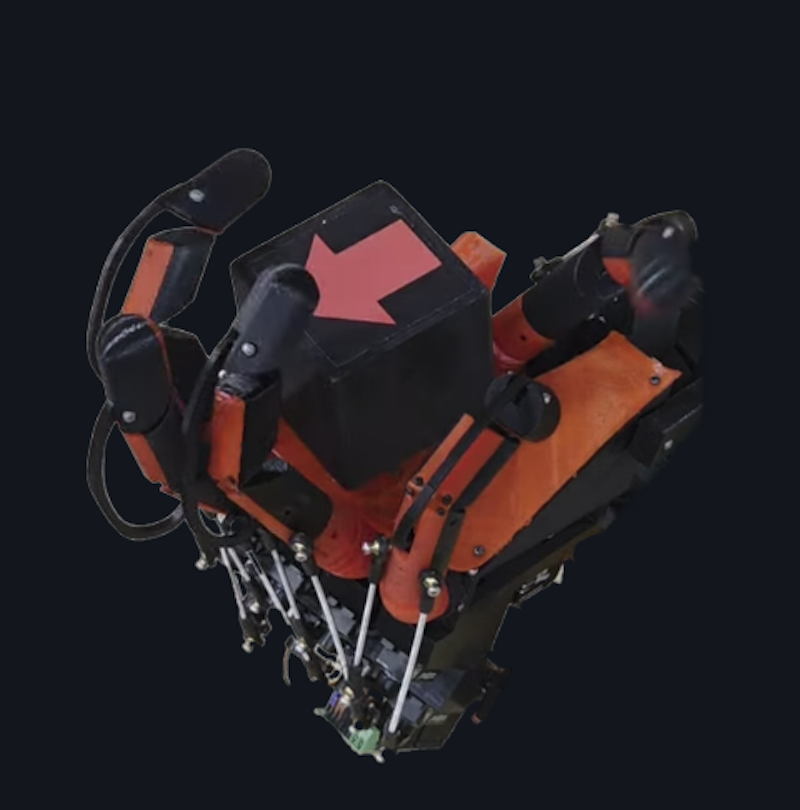
Researchers at the New Jersey Institute of Technology have built a five-fingered robotic hand, called PHD-Hand, that costs less than $650 in components while demonstrating all 33 grasp types in the standard GRASP taxonomy. The work, led by Neel Adwani alongside Muhaiminul Islam Akash, Saffia Ouali, Ethan Liu and Cong Wang, has been accepted at the IEEE-RAS International Conference on Humanoid Robots (Humanoids 2026) and posted on arXiv.
What makes this hand different from other low-cost designs?
PHD-Hand uses a linkage-driven mechanism rather than the tendon-and-pulley systems common in budget robotic hands. Each of the five digits has three actuated degrees of freedom, for 15 total, and is built from 18 major components including 3D-printed thermoplastic polyurethane flexible hinges and spring steel drive rods. The hand is roughly 200 millimeters long and is driven by generic miniature RC servos controlled through a Pololu Mini Maestro 18 board, all off-the-shelf parts rather than custom actuators.
The linkage design is bidirectional and backdrivable in both directions, meaning external forces can push the fingers back through the mechanism safely instead of stalling or damaging the servos, a property that matters for hands expected to make contact with unpredictable objects and surfaces.
How capable is it compared to commercial robotic hands?
In testing, PHD-Hand rotated a 55-millimeter cube in-hand, manipulated jar lids, handled a precision screwdriver, and adjusted a wrench's screw, tasks that require fine finger coordination rather than just a power grip. Commercial dexterous hands used in humanoid robots and prosthetics often run into the thousands or tens of thousands of dollars; PHD-Hand's bill of materials sits under $650, a difference researcher Neel Adwani points to directly, noting that hands remain one of the hardest and most expensive parts of a humanoid robot to get right.
Why does hand cost matter for the humanoid robot industry?
Hands and fingers are frequently cited as the most failure-prone and expensive subsystem on humanoid robots, driving a wave of specialized robot-hand startups and funding rounds in 2026. A hand design that is open-source, repairable with a 3D printer, and built from generic servos could lower the barrier for university labs, hobbyists and smaller robotics companies that cannot afford commercial dexterous-hand suppliers. The team plans to release the full design as open source on GitHub, which would let outside groups replicate, modify and test the design themselves rather than relying on proprietary hardware.
What are the current limitations?
The paper doesn't claim PHD-Hand matches the grip strength, speed or durability of commercial dexterous hands designed for continuous industrial duty cycles; its value proposition is accessibility and replicability, not raw performance. Whether it holds up outside a lab environment, under repeated use and real payloads, is the open question the open-source release should help answer once other groups start building and testing their own copies.
Source: Robotics and Automation News