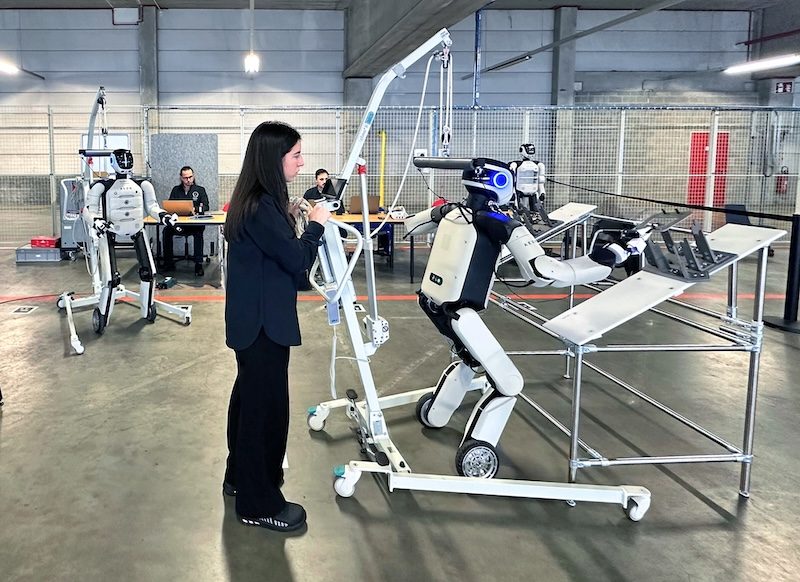
Volvo Cars has started training Hexagon Robotics' AEON humanoid robots at its manufacturing plant in Ghent, Belgium, marking the automaker's first trial of humanoid machines on a production line. The current phase has the robots learning to place components into two fixtures with precision, using imitation learning so the machines can watch and copy human demonstrations.
What is the robot actually doing right now?
In this initial stage, AEON is limited to a narrow, repeatable task: picking up parts and inserting them into two designated fixtures with consistent accuracy. It is not yet roaming the shop floor or handling a variety of components. Hexagon and Volvo describe this as a deliberate first step before widening the robot's job list.
AEON stands 1.65 meters tall, weighs 60 kilograms, and carries payloads up to 10 kilograms. Unlike legged humanoids from rivals such as Figure or Tesla, AEON moves on a wheeled base and can reach 2.4 meters per second, trading rough-terrain mobility for faster, more predictable movement on a flat factory floor.
Why choose a wheeled humanoid instead of a legged one or a standard cobot?
Volvo Cars chief marketing officer Magnus Nilsson said AEON's human-like shape lets it work inside production lines built around human reach and ergonomics without requiring a redesign of the workstations themselves. That is the core argument automakers are making for humanoids generally: decades-old factories don't need to be rebuilt to accommodate a machine shaped like a person.
Hexagon Robotics president Arnaud Robert said the company is working closely with Volvo's own teams to make sure AEON performs tasks that genuinely support the manufacturing process, rather than tasks chosen for a demo reel. That distinction matters in an industry where many humanoid trials never progress past staged pilots.
How does this compare to other automakers testing humanoids?
Volvo joins a growing list of carmakers piloting humanoids on real lines, including Mercedes-Benz with Apptronik and BMW with Figure. What sets this deployment apart is the timeline: Hexagon and Volvo have set concrete dates, with a larger pilot involving additional AEON units planned for the first half of 2027, and an introduction into actual production operations targeted for mid-2027. Many competing humanoid trials remain open-ended demonstrations without a stated production date.
What happens next, and what could slow it down?
The jump from placing parts in two fixed locations to navigating a dynamic production area alongside human workers and existing automation is a significant one. Hexagon's own Autonomy Unlocked research found only 16% of UK respondents report high or full autonomy comfort with such systems, versus 29% in China, a gap that could shape how fast Volvo scales this beyond Ghent. The next milestone to watch is whether the 2027 pilot expands AEON's task list beyond fixture placement before the mid-2027 production target.
Source: Robotics and Automation News