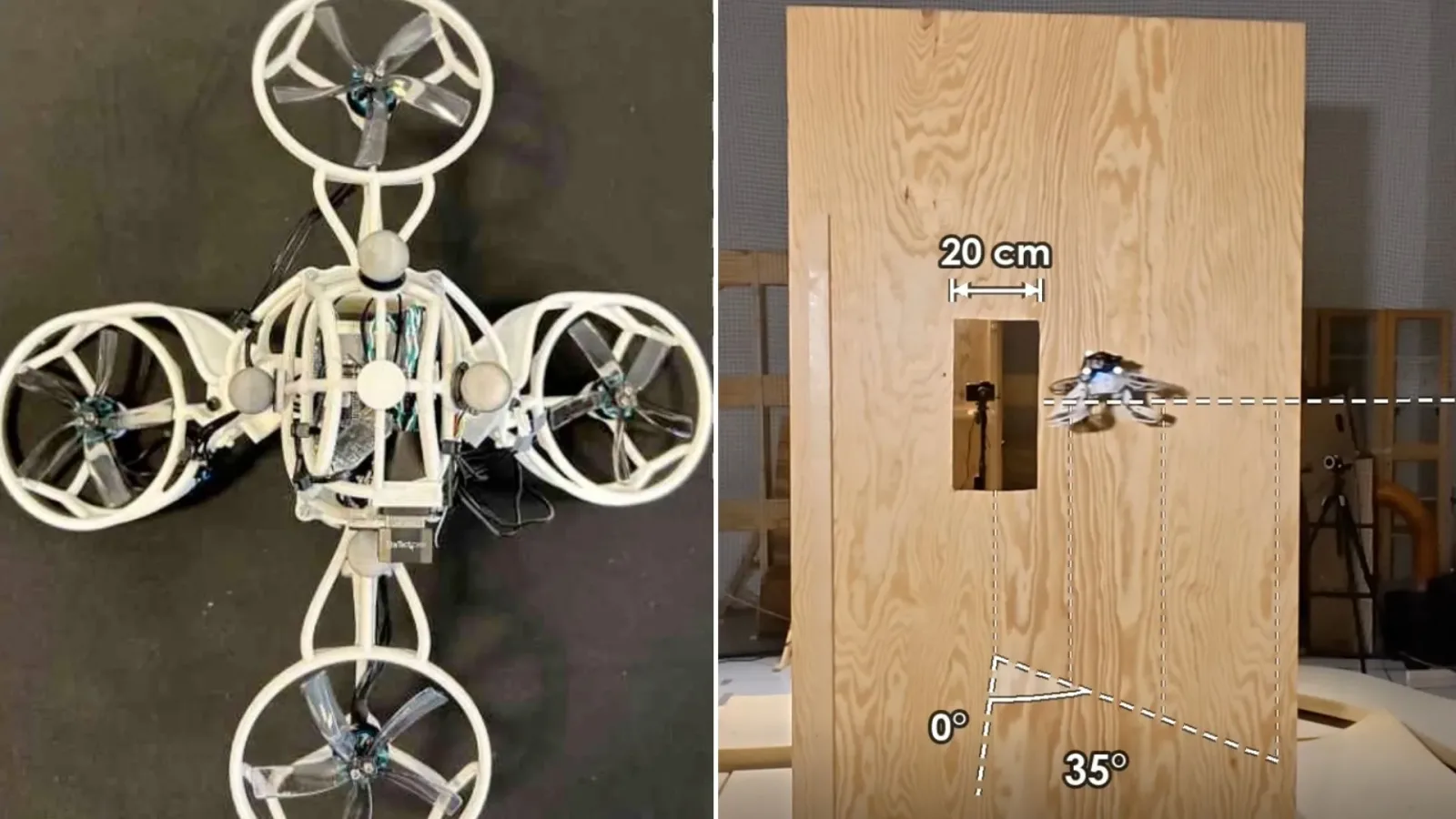
Researchers from the Autonomous Robots Lab at the Norwegian University of Science and Technology (NTNU) and the Mobile Robotics Lab at ETH Zurich have built a quadrotor drone with soft, spring-loaded arms that fold inward on contact, shrinking its width from 31.3 centimeters to 14.1 centimeters before snapping back open mid-flight. The prototype can cross gaps 52% narrower than its normal wingspan while flying at 2 meters per second, according to a preprint posted on arXiv in November 2026.
Each side arm pivots on what the team calls an elastic rolling cam joint, a single-degree-of-freedom mechanism built from two spring-loaded cams with interlocking teeth that roll against each other without slipping. The design lets the arms compress under contact force and return to full extension once the pressure is gone, without motors or added electronics driving the fold.
Why the engineering is notable
Most collision-tolerant drones trade stiffness for compliance everywhere on the frame, which tends to hurt flight precision and add power draw during normal operation. This design confines the compliance to two arms and optimizes airframe geometry and joint stiffness together in a closed loop, using simulated gap-traversal success as the feedback signal. The result, per the paper, is a drone that adds less than 1% extra power consumption during contact-free flight and only a modest increase in position error compared with a rigid twin of the same frame.
The team also tested the drone against a 40-centimeter-long tube with a 22.5-centimeter diameter, 28% narrower than the drone's resting width, and found it could tolerate up to 30 degrees of approach-angle misalignment while still folding through successfully. That tolerance matters for real-world use, where a drone rarely approaches an opening dead-center.
Where this fits in drone development
Narrow-gap traversal has been a persistent problem for aerial robots working in cluttered environments such as collapsed buildings, pipe networks, dense forestry or industrial plants full of ductwork and scaffolding. Past approaches have generally picked one of two extremes: fully rigid drones that simply cannot fit through tight openings, or fully soft airframes that sacrifice flight stability and payload capacity everywhere, not just at the point of contact. The NTNU and ETH Zurich design tries to split the difference by keeping the core airframe rigid and concentrating compliance only where it is needed.
The authors, who include Etor Arza, Javier Paez and Kostas Alexis from NTNU, Luca Girardi, Gabriel Maquignaz and Stefan Leutenegger from ETH Zurich, and Stefano Mintchev from the University of Bonn, published their closed-loop optimization method alongside the hardware results and released open-source code so other labs can apply the same design process to different drone sizes or gap dimensions.
What comes next
The work remains a research prototype rather than a deployable product, and the team's own numbers show a tradeoff: added position error during flight, even if modest. The next test for designs like this will be whether the folding mechanism holds up outside lab conditions, across repeated contacts, dust, and the kind of variable lighting and debris found in actual disaster sites or industrial inspections. If the mechanism scales reliably, it could feed into inspection and search-and-rescue drones built by companies already selling into those markets, giving them a way to reach spaces current fleets have to fly around.