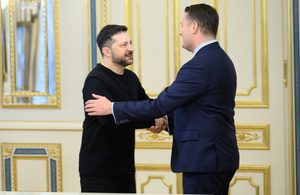
The United Kingdom and Ukraine signed agreements in Kyiv on November 21 to manufacture Ukrainian-designed strike drones on British soil, with UK funding covering production and delivery to Ukraine's armed forces. Defence Secretary Wes Streeting signed the arrangements alongside President Volodymyr Zelenskyy and Defence Minister Yevhenii Khmara.
According to a UK government statement, the deal covers both "middle strike" drones, flown roughly 35 to 300 kilometers behind the front line, and longer-range "deep strike" drones capable of hitting targets far inside Russia. Maritime, logistics and surveillance drones are also included in the arrangement.
Money behind the drones
The agreements sit inside a wider financial package: a £500 million military support commitment announced at the UK Budget, £240 million pledged through the Ukraine Defence Contact Group in Brussels, and £260 million agreed at a Coalition of the Willing leaders' meeting. The UK says it has committed £3 billion a year in long-term support. Officials said more than 80% of the £260 million tranche is expected to flow to UK companies, including small and medium-sized manufacturers, rather than foreign suppliers.
The same visit also covered over 1,000 air-defence missiles with launchers and more than a dozen radars for Ukraine, plus a push to speed deliveries of Lightweight Multirole Missiles from existing British stockpiles to help intercept Russian drones. More than 1,000 long-range strike drones are referenced in the broader support package tied to the visit.
Why drone manufacturing is moving West
Ukraine has spent the war building its own drone industry largely out of necessity, scaling domestic producers of strike drones like the Liutyi after Western supply chains proved too slow or too limited for the volumes needed. Shifting some of that production to UK factories marks a shift: instead of only buying finished Ukrainian drones or shipping Western-made alternatives, London is now manufacturing Ukrainian designs domestically, which should insulate output from battlefield disruption to Ukraine's own factories and give UK industry direct experience building combat-proven drone designs.
It also follows a broader pattern this year of European governments localizing Ukrainian drone and munitions production rather than simply funding exports, as seen in Germany's recent moves to co-produce strike drones and expand attack-drone output with Ukrainian partners.
Streeting framed the visit in blunt terms: "Ukraine's front line is our front line for freedom and democracy. I'm here to make sure that we lead by example." Zelenskyy's response pointed to urgency over symbolism: "It's not about words. It's about real steps to strengthen our army first."
Neither government has published a timeline for when UK-built drones will reach Ukrainian units, or disclosed unit numbers tied specifically to the new manufacturing agreements. That detail, along with which UK facilities will host production, is expected to emerge as contracts are finalized in the coming weeks.