
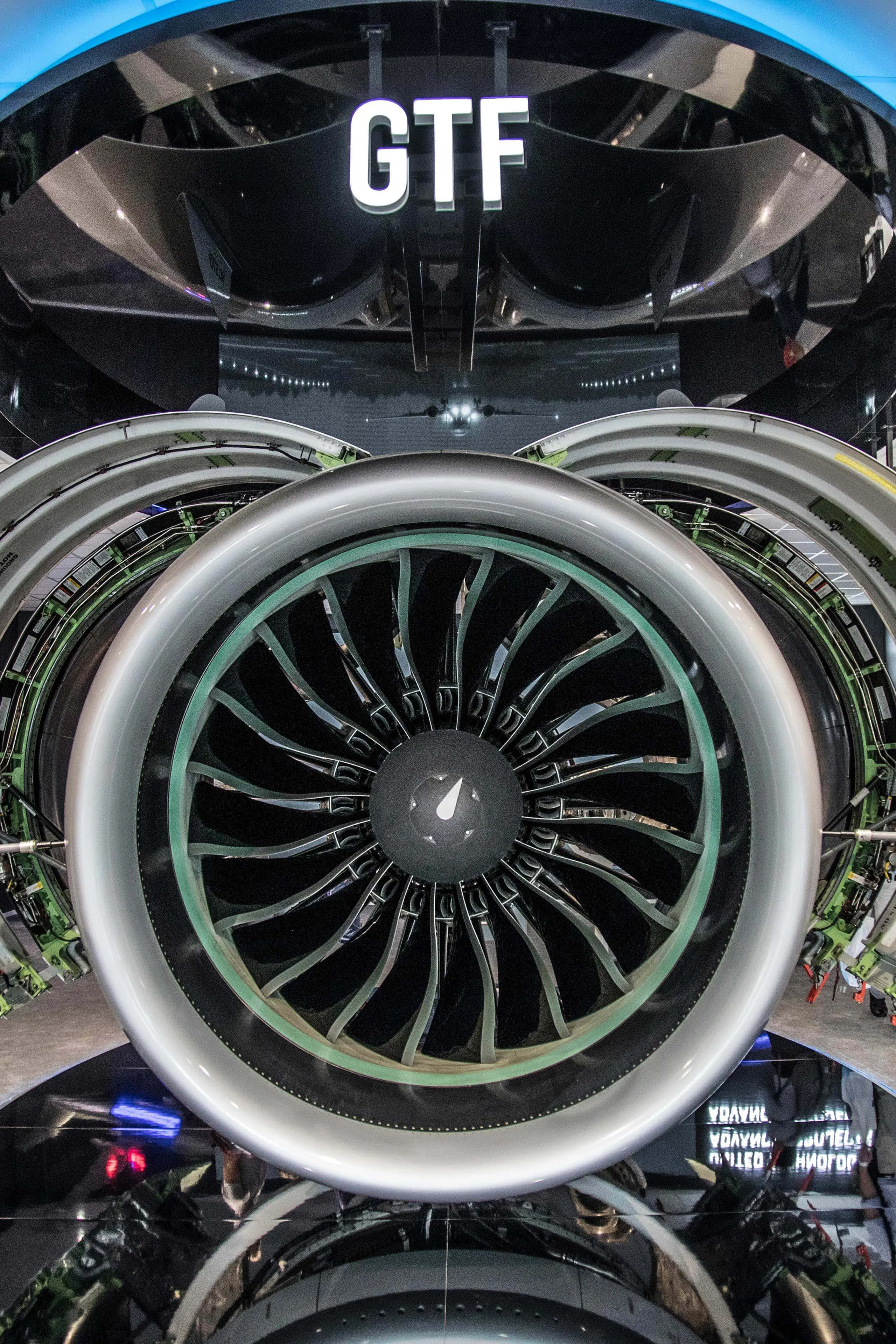
Pratt & Whitney is folding ceramic matrix composites and composite fan blades into its NextGen2 geared turbofan, the RTX unit's proposed engine for the airplane that will replace the Airbus A320 and Boeing 737 families, Leeham News reported on July 20, 2026. The move sees Pratt adopting the two hot-section technologies GE Aerospace pioneered on the LEAP a decade ago, at the same time GE's CFM joint venture with Safran is embracing the geared architecture Pratt used as the foundation of its original GTF.
Convergent bets after a decade of disagreement
When Pratt and CFM launched the GTF and LEAP in the 2010s, each company publicly downplayed the other side's architecture. Ten years later, both are quietly integrating the ideas they dismissed. Pratt's NextGen2 remains a traditional ducted turbofan, but its hot section will now use CMC turbine shrouds and airfoils to run hotter for less cooling air, and its fan module will use composite blades to cut weight and manage a larger fan diameter without over-stressing the gearbox.
CFM stays with RISE and the open fan
CFM International, jointly owned by GE Aerospace and Safran, is placing its bet on the RISE program's open fan engine architecture — an evolution of 1980s open rotor concepts, but with a single unducted fan and non-rotating outlet guide vanes rather than counter-rotating blades. Composite blades are a key element in mitigating concerns about a blade-out event on an open fan, and GE says its composite blades on Boeing and Airbus airplanes have accumulated millions of flight hours without a blade-out.
Rolls-Royce readies UltraFan 30
Rolls-Royce, absent from single-aisle engines today, is developing its UltraFan family in two phases: the original 85,000-lb-thrust UltraFan that ran on-test in 2023 for widebody programmes, and a smaller UltraFan 30 in the 30,000–35,000-lb thrust class targeted at the next narrowbody replacements, with a demonstrator planned for ground testing in 2028. All three engine makers now converge on some form of geared architecture and composite/CMC materials, even as they differ on ducted-versus-open.
What it means for the next narrowbody
Airbus and Boeing are both working toward a next-generation single-aisle programme that could enter service in the mid-to-late 2030s, with efficiency gains in the 20–25% range over today's A320neo and 737 MAX. Achieving that step change requires engines with much lower fuel burn, and both CMC-heavy ducted engines and open-fan architectures are being sized against airframe drag, noise and airport-compatibility constraints. Pratt's NextGen2 sits alongside the certified GTF Advantage that just won new business at Farnborough, while giving Pratt a technology roadmap that finally covers hot-section composites.
Reporting based on coverage from Leeham News/AIN.