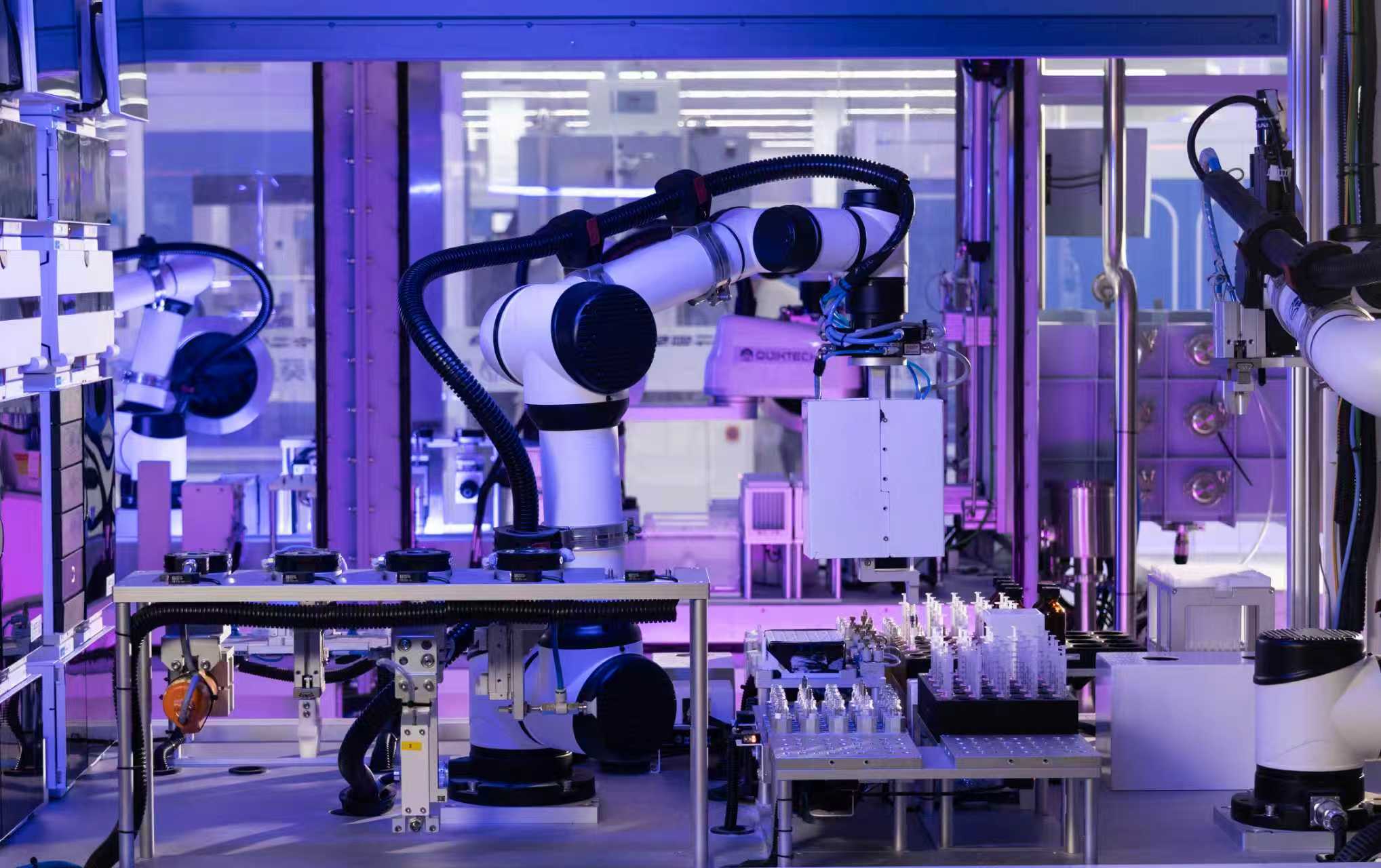
QuikTech, a Beijing-based company that builds autonomous robotic laboratories, has raised a Series A round exceeding 100 million yuan, or roughly $14 million, the company announced on November 13, 2026. The round was backed by Chuangdongfang Investment, Feirongyuda and Jinhui Big Data, according to 163.com. Founder Chen Nanjiang, a Beihang University PhD, started the company in 2021 and describes it as a 'physical AI' firm rather than a pure software shop.
That framing matters. QuikTech is not selling a chatbot for scientists. It is selling robots that run the experiments themselves, overnight, without a human pipetting anything.
Robots That Design and Run Their Own Experiments
QuikTech's platform has three layers. NexoLab is the physical hardware: automated synthesis and testing equipment that handles the actual chemistry. AI-LabOS is the operating system that schedules and coordinates that hardware. MoleMind is the AI layer that designs experiments, interprets results and decides what to try next, closing the loop between a hypothesis and a lab bench.
The company already counts the Chinese Academy of Sciences' Shanghai Institute of Organic Chemistry, Boehringer Ingelheim, French materials group Arkema, Hengrui Pharmaceuticals and battery maker Guoxuan High-Tech among its users. That spread matters: pharma, materials science and battery chemistry all run on the same underlying automation stack, which is the pitch QuikTech is making to investors and to its own sales team. One robotic lab platform, many industries, recurring revenue instead of one-off equipment sales.
The new money is earmarked for three things: core technology R&D, expansion into priority industries, and construction of what the company calls its Qingkui Xingyao Cloud Lab, a shared facility meant to let smaller customers rent automated lab time instead of buying the hardware outright. That cloud-lab model is the clearest sign QuikTech wants to be an infrastructure provider, not just an equipment vendor.
A Crowded Field Betting on Self-Driving Science
QuikTech is entering a market that is heating up globally. In the US, Emerald Cloud Lab and Future House have pushed similar ideas of remote-operated or AI-directed experimentation, while large pharma companies are building internal automation teams of their own. China's push is distinct in scale and ambition: Beijing has made 'AI for Science' a named priority in recent industrial policy, and venture money is following, with autonomous lab startups multiplying across chemistry, materials and battery research.
The $14 million round is modest next to the sums flowing into general-purpose foundation models, but it is a meaningful bet on a narrower thesis: that physical AI pays off fastest in science, where an experiment that used to take a human a day can run unattended overnight, and where failures are cheap data rather than wasted shifts.
What to watch next is whether QuikTech can convert pilot customers like Boehringer Ingelheim into recurring cloud-lab subscribers, and whether its MoleMind models can be shown to actually accelerate discovery timelines rather than just automating existing workflows. Investors in autonomous labs everywhere are asking the same question: is this faster science, or just more expensive automation?