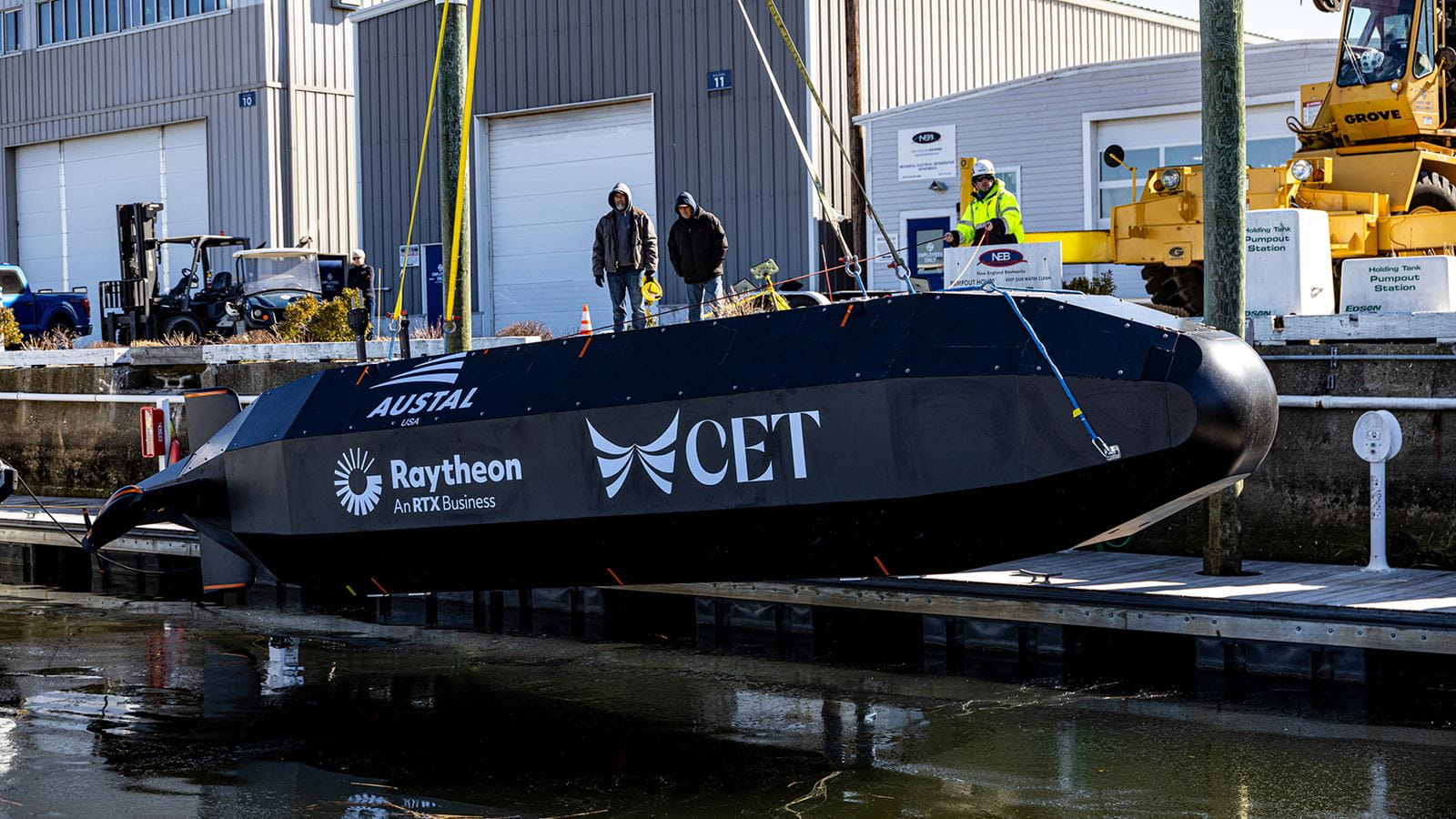
Raytheon and Composite Energy Technologies have carried out the first submerged launch of HADALUS, a new low-cost, long-endurance unmanned undersea vehicle, in a recent U.S. Navy exercise off Portsmouth, Rhode Island — a milestone that the two companies say opens a path to end-to-end autonomous undersea missions.
34-Foot UUV, 2,000+ Nautical Miles
HADALUS is a 34-foot vehicle with a six-foot cross section and more than 2,000 nautical miles of endurance. Its free-flooded, all-carbon-fiber exoskeleton is designed to deliver higher payload capacity and structural strength at roughly one-third to one-fifth the cost of comparable long-endurance UUVs, according to the companies. The pair says it went from a conceptual sketch to a full prototype in less than 18 months, driven by joint investment in design, build, launcher and sensor integration, and full-system testing.
Detect, Reacquire, Engage — From One Platform
“This demonstration is an important step in a broader roadmap to deliver autonomous, end-to-end undersea capabilities that are far less detectable than surface platforms,” said Jen Gauthier, Raytheon vice president of Naval Systems & Sustainment. Raytheon calls it the first time the U.S. Navy has seen an integrated detect-reacquire-engage capability from a single unmanned undersea platform in the water. CET chief executive Chase Hogoboom said the demo shows the undersea industrial base can move faster than traditional development cycles.
Context
The demo lands as the U.S. Navy accelerates its unmanned undersea vehicle programs and as Congress presses for lower-cost autonomous platforms. Related coverage: Ondas’ Mistral wins a $50M U.S. Army order for lethal unmanned systems, AeroVironment’s AV Eagle UAS plant in Greece, and Elbit-Serbia’s UAV joint venture near Belgrade.
Reporting based on coverage from Raytheon, Seapower Magazine, Military Embedded Systems and Interesting Engineering.