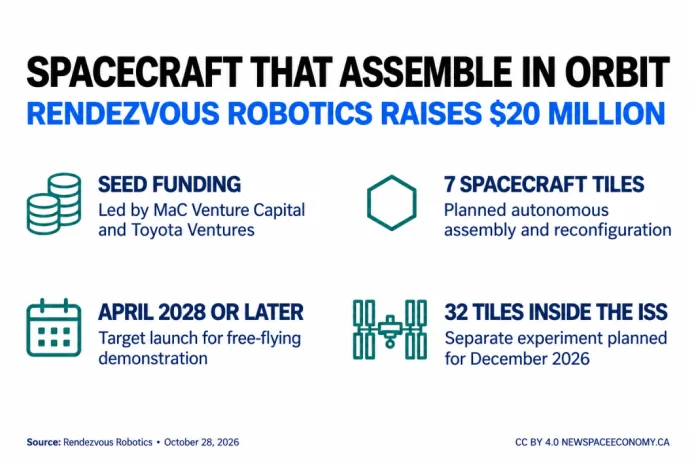
Rendezvous Robotics, a Golden, Colorado startup, announced on October 29, 2026 that it raised $20 million in an oversubscribed seed round co-led by MaC Venture Capital and Toyota Ventures, with the University of Michigan Endowment, Astera, Industrious Ventures, Aurelia Foundry, ATX Venture Partners and Mana Ventures also participating. The company builds modular spacecraft tiles that launch separately and then autonomously maneuver, align and physically connect once they're in orbit, according to New Space Economy.
The technology, called TESSERAE, grew out of nearly a decade of research by co-founder and board chair Dr. Ariel Ekblaw, who developed the self-assembly concept at MIT. Rendezvous has already flown earlier TESSERAE prototypes on Blue Origin's New Shepard and two prior International Space Station missions. The company is headquartered in Golden, Colorado, and co-founded by Ekblaw and CEO Joe Landon.
How does a robot assemble a spacecraft by itself?
Each Rendezvous tile is a roughly one-meter-wide hexagonal panel packed with sensors, onboard processing, electromagnetic actuators and mechanical latches. Picture a robotic puzzle piece that can sense where its neighbors are, steer itself into position using its own thrusters, and lock on with a physical latch once it's aligned, no astronaut and no robotic arm required. Because each tile makes its own navigation and docking decisions, the full structure doesn't need a central controller directing every move.
That self-assembly is the whole point. Dr. Ekblaw put the constraint plainly: "For decades, the way we build spacecraft has been shaped by what we can fit inside a rocket." Every satellite, station module or telescope today is limited by a rocket's fairing, the nose cone that has to hold the entire payload during launch. Rendezvous's bet is that if you split a large structure into many small, identical tiles, you can launch them separately on cheaper, smaller rockets and let the tiles build the final structure themselves once they're already in space. Michael Palank of MaC Venture Capital summed up the shift: the company isn't finding better ways to package a spacecraft for launch, it's rethinking how spacecraft get built in the first place.
Why now, and what's the actual test plan?
The $20 million funds two concrete demonstrations rather than a far-off roadmap. In December 2026, 32 fifth-generation TESSERAE tiles will fly to the ISS and autonomously form a three-dimensional structure, the largest self-assembly test the company has run. The bigger milestone comes no earlier than April 2028, when seven independently launched tiles are meant to join together in orbit, form a single spacecraft, separate back into pieces, and reassemble into a different configuration, proving the system can reconfigure on demand rather than just snap together once.
That reconfigurability is the commercial pitch. A satellite built from swappable tiles could, in theory, be repaired, upgraded or resized in orbit instead of being replaced outright, a capability the current generation of built-to-spec satellites doesn't have. Rendezvous says it's targeting commercial, civil and national-security customers, all of whom have reasons to want structures that can grow or adapt after launch rather than being locked into a single design.
The round's size is modest by robotics standards, but the backing from Toyota Ventures and an oversubscribed book suggest investors see the self-assembly approach as a hedge against the industry's two biggest constraints: launch costs and rocket fairing size. If the April 2028 demo works, Rendezvous will have a case study that no other in-space assembly company can currently show.