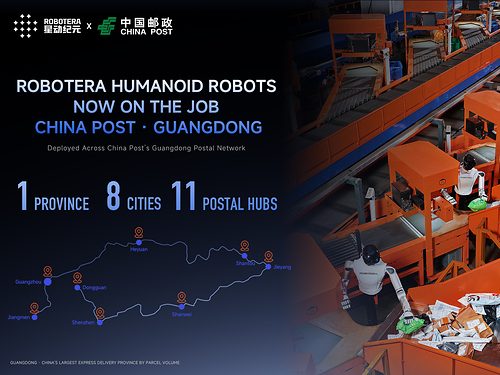
ROBOTERA, a Beijing-based humanoid robot maker also known as Xingdongjiyuan Technology, announced on November 17, 2026 that its robots are now operating at 11 postal hubs across eight cities in China Post Group's Guangdong Branch network, up from a single pilot site when the project started in March 2026. The company calls it the largest and most geographically extensive deployment of embodied-intelligence robots in logistics to date.
The robots are installed in Guangzhou, Shenzhen, Dongguan, Jiangmen, Shantou, Shanwei, Jieyang and Heyuan, running parcel induction at an average rate of more than 1,500 parcels per hour, a pace ROBOTERA says matches experienced human sorters. The machines use a self-developed five-finger dexterous hand, can reject irregularly shaped items that risk jamming the line, and adjust their working speed automatically to avoid collisions with conveyor equipment or other robots on the floor.
Why the Scale-Up Matters
Humanoid robots have spent much of 2026 moving from single-site pilots to multi-site rollouts, and postal and parcel sorting is turning into one of the clearer early use cases because the task is repetitive, high-volume and already heavily automated at the conveyor level. Going from one site in March to 11 hubs across eight cities in eight months is a faster expansion curve than most industrial humanoid deployments have managed this year, and it gives ROBOTERA a large, standardized dataset of real-world grasping and sorting footage to refine its hand and locomotion software.
The deployment also puts ROBOTERA alongside a growing list of Chinese humanoid makers chasing logistics contracts, including AgiBot and UBTech, both of which have landed retail and automotive floor deals this year. China Post's willingness to scale a single vendor across an entire provincial branch, rather than keep testing in isolated pilots, signals that at least one state-linked logistics operator sees the economics working at scale, not just in a lab.
What Happens Next
ROBOTERA has not disclosed the total number of robot units deployed across the 11 hubs or a timeline for expanding beyond Guangdong province. The company says its robots offer multiple power configurations to suit different site requirements, suggesting it is positioning the platform for postal and warehouse operators with varying infrastructure. Whether China Post extends the program to other provinces, or whether rival operators move to match it, will be the next signal of how fast humanoid sorting scales nationally.