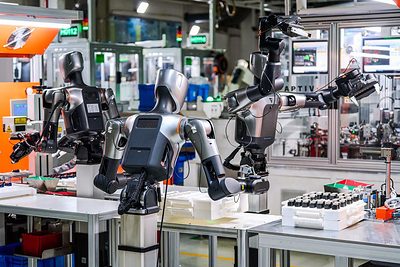
Chinese embodied-AI startup TARSBOT and auto-technology supplier Aptiv signed an agreement in Shanghai on November 16, 2026, during the China International Import Expo, to deepen a collaboration that will put 100 of TARSBOT's A-Series industrial humanoid robots to work by the end of this year. The deployment spans eight manufacturing process categories and 33 application scenarios, including flexible assembly, coordinated inspection and production management, according to a joint press release. A first batch of robots is already running in real production-line conditions inside an Aptiv smart factory.
Aptiv is contributing high-performance computing platforms and power-distribution hardware that serve as the \"computing foundation\" for the robots' perception, decision-making and motion-control systems. The two companies describe the 100-unit rollout as a step toward a longer-term fleet of 1,000 industrial humanoid robots, a target developed in coordination with the Shanghai Jiading District government, which is positioning the district as a hub for embodied-AI manufacturing.
A supplier-funded path to scale
TARSBOT, formally Shanghai TASHI Zhihang Technology, was founded in February 2025 and unveiled its first A-Series and T-Series prototypes only in December of that year — making this deployment one of the fastest moves from prototype to production-floor fleet in China's crowded humanoid sector. The arrangement with Aptiv is unusual in that a global auto-parts supplier is effectively co-engineering the compute and power stack rather than simply buying finished robots, giving TARSBOT a hardware partner with deep industrial-reliability experience and giving Aptiv an early foothold in embodied AI without building a robotics division from scratch.
Competing for China's industrial humanoid market
The 1,000-unit ambition places TARSBOT alongside better-funded rivals such as UBTech, AgiBot and Unitree, all of which have announced four-figure humanoid deployment targets with Chinese manufacturing and logistics partners this year. What distinguishes the TARSBOT-Aptiv plan is its narrow task scope — 33 defined scenarios inside existing automotive-parts production, rather than the open-ended \"general-purpose\" framing many humanoid makers use. That specificity could make the 100-unit milestone easier to hit on schedule, but it also means TARSBOT's near-term revenue depends heavily on one customer relationship and local government backing rather than a broad commercial order book. Scaling from 100 to 1,000 units will test whether the AWE foundation model the companies are jointly developing can generalize across the full range of Aptiv's production lines, or whether each new scenario will require fresh engineering.