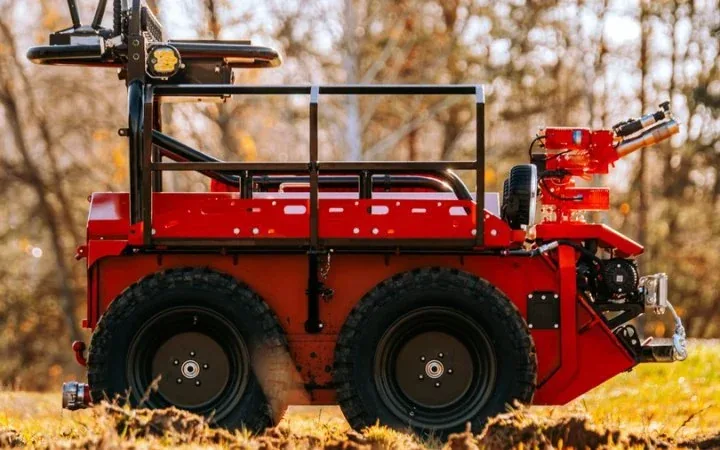
Ukrainian robotics firm Rovertech unveiled an updated version of its ZMIY Firefighter unmanned ground vehicle on November 27, developed jointly with the State Emergency Service of Ukraine (SES). The headline addition to ZMIY Firefighter 2.0 is a casualty-evacuation body fitted with doors and a folding stretcher, turning a machine built to fight fires into one that can also pull injured people out of danger zones.
The vehicle weighs 1,300 kg, tops out at 8 km/h, and has an operating range of 20 to 40 km depending on load and lighting conditions. Its firefighting monitor nozzle aims across 110 degrees vertically and 130 degrees horizontally, throwing a jet up to 50 meters at 11 bar and 50 liters per second, backed by six protective sprinklers using 30 liters per minute. A three-camera system combining thermal, wide-angle and narrow-angle views feeds operators real-time footage, and a loudspeaker with two-way audio lets rescuers communicate with anyone found at the scene.
Why Casualty Extraction Changes the Robot's Role
Firefighting robots have typically been built to do one job: suppress fire from a safe standoff distance while keeping crews out of structurally unstable or chemically hazardous environments. Adding a stretcher and evacuation body shifts ZMIY Firefighter from a suppression tool into a combined rescue platform, a distinction that matters directly in a war zone where secondary explosions, unexploded munitions or structural collapse can make it too dangerous to send in a human rescue team even after a fire is under control. The robot's rated payload of 500 kg, tested up to 1.5 tonnes, and towing capacity of 1,000 kg with a 1,500-2,000 kg winch give it enough margin to extract a person and equipment in a single trip.
How It Fits Ukraine's Push for Field-Tested Rescue Robotics
Ukraine has become a proving ground for unmanned ground vehicles across evacuation, logistics and demining roles, with the war creating faster feedback loops between frontline units and manufacturers than peacetime defense procurement typically allows. Rovertech's partnership with the SES, a civilian emergency agency rather than a military branch, points to a parallel track of robotics development aimed at firefighters and first responders operating in contested or recently shelled areas, distinct from strictly combat-focused UGVs. The new hybrid multi-channel communications system, which automatically monitors signal quality and switches backup channels for short, medium and ultra-long distances, and a portable ground station deployable in under two minutes, both address a recurring complaint from Ukrainian operators: that electronic warfare and jamming routinely sever control links to unmanned systems mid-mission. Whether ZMIY Firefighter 2.0 sees wide deployment will likely depend on how reliably that communications layer holds up once it faces active jamming in the field rather than controlled testing.