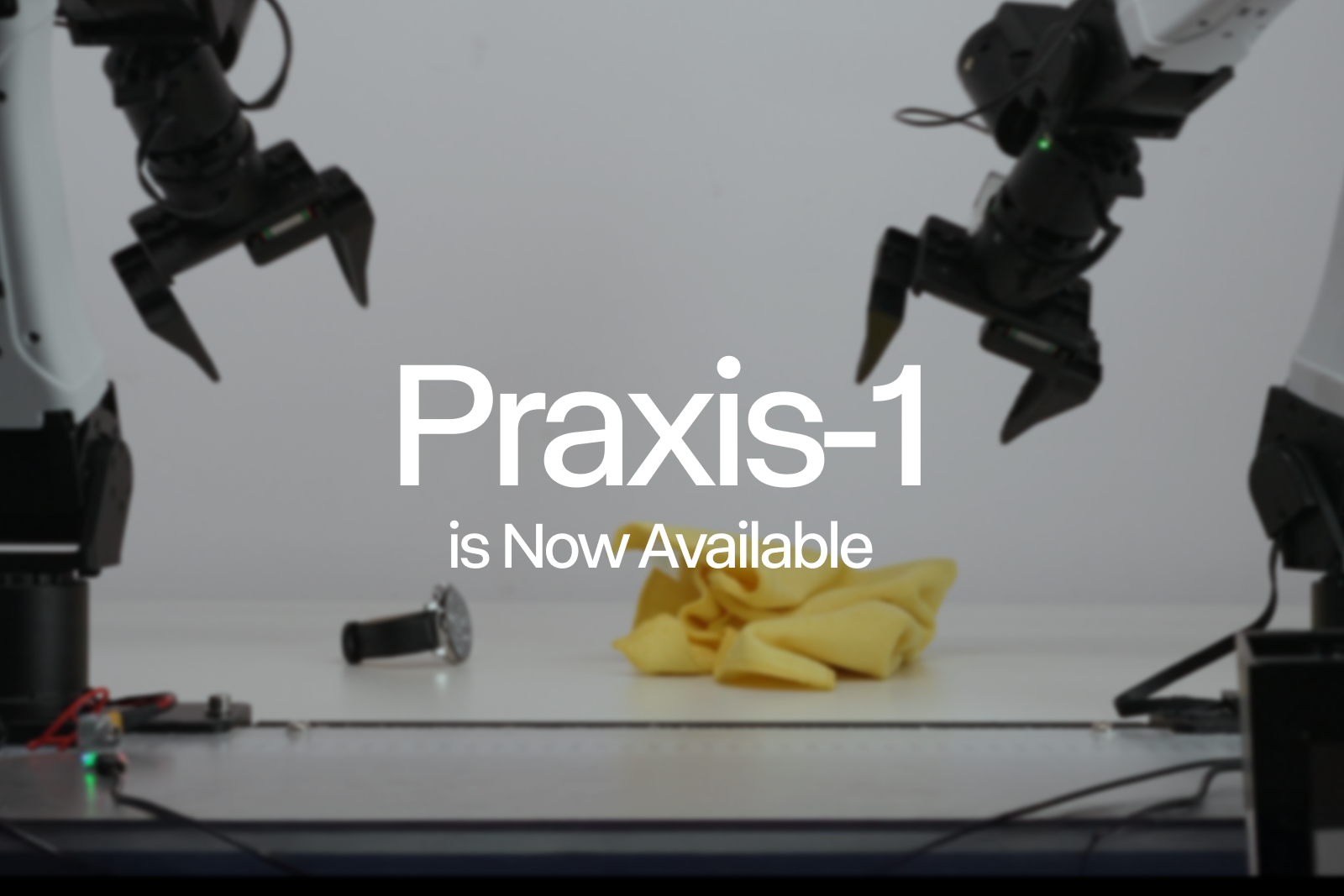
Runway AI released Praxis-1, its world action model for robotics, as a fully open-weight system under the Apache 2.0 license on November 11, 2026. The 27-billion-parameter mixture-of-experts diffusion transformer scored 46.2% success across 1,200 episodes on Nvidia's RoboLab-120 leaderboard, ahead of FLUX 3 Action at 42.9%, Cosmos3 Nano at 36.8% and π0.5 at 28.0%. On a separate test, SimplerEnv, running Google's RT-1 robot, Praxis-1 reached 80.0% success compared with 52.4% for RT-1's original policy. Launch partners running the model on physical hardware include Noble Machines on a legged humanoid, Standard Bots on a six-axis industrial arm, and Ultra on a dual-arm warehouse robot.
Betting Video Data Beats Scarce Robot Demonstrations
The scarcity of robot demonstration data has long been the central bottleneck in training machines to handle new objects and environments. Collecting it requires physical robots, human teleoperators and controlled environments, which is slow and expensive at scale. Praxis-1 sidesteps this by leaning on Runway's existing video-generation expertise: the model first predicts what the world will look like after a given action, using a video backbone, then an "action expert" extracts the motion that would produce that imagined future. Per-robot projections then translate this motion into whatever pose and action format a specific machine needs.
This approach treats internet-scale video, which is effectively unlimited, as a substitute for hard-to-collect robot trajectories. Andy Chen, Runway's head of robotics, said the model "learned it from half an hour of examples and got it right 15 times out of 15," pointing to how little task-specific data Praxis-1 needs once it already understands how objects and physics behave from video pretraining.
Open Weights in a Field That Mostly Isn't
Most leading robot foundation models, including Google DeepMind's Gemini Robotics lineage and Physical Intelligence's π-series, are released with limited or no public access to weights, treating the underlying model as proprietary infrastructure. Nvidia's own Cosmos models have taken a more open stance, and Praxis-1's release under Apache 2.0 — permitting commercial use with no licensing fees — pushes further in that direction, giving hardware makers the ability to run, inspect and modify the model themselves rather than renting access to a closed API.
The trade-off for Runway is monetization: an openly licensed model doesn't generate direct subscription revenue the way its video-generation tools do. The bet instead appears to be ecosystem capture — becoming the default "brain" that smaller hardware makers like Noble Machines and Standard Bots build around, rather than developing in-house alternatives or defaulting to Nvidia's own stack. Whether that pays off depends on whether Praxis-1's lead over FLUX 3 Action and Cosmos3 Nano holds up as rivals iterate, and whether real-world deployments outside controlled benchmarks match the RoboLab-120 numbers.
Source: Runway