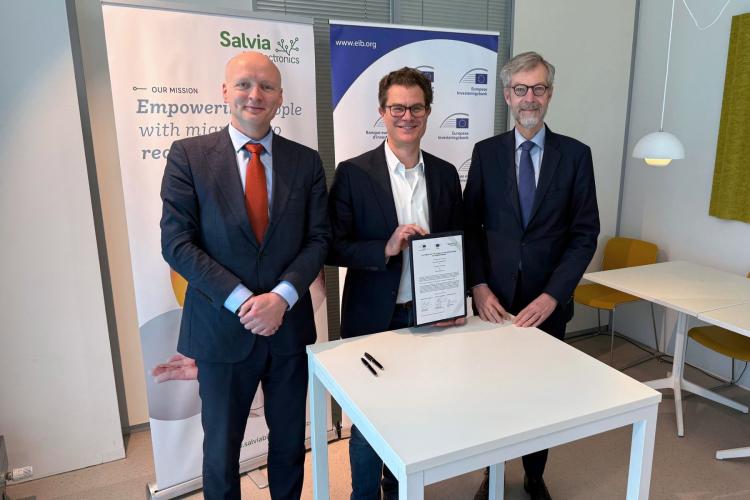
Salvia BioElectronics has secured €25 million (about $27.4 million) in venture debt from the European Investment Bank, backed by the EU's InvestEU programme. The Eindhoven-based medtech company announced the financing on November 24, 2026, earmarking it for continued clinical development of its implantable migraine therapy, according to the European Investment Bank.
What exactly is MySalvia, and who is it for?
MySalvia is an implantable neuromodulation system built for people with treatment-resistant migraine — patients who don't respond to existing drugs or injections. The system pairs two ultra-thin implants with a wearable component that delivers targeted electrical stimulation to nerves involved in triggering migraine attacks.
The device already holds FDA breakthrough device designation, granted in 2020, and is now in the pivotal RECLAIM-II study in the United States, alongside parallel evaluation sites in Europe assessing safety, durability and efficacy in adults with chronic resistant migraine.
Why debt instead of another equity round, and how much has Salvia raised overall?
Venture debt lets Salvia fund trial work without further diluting existing shareholders. This EIB facility arrives about 18 months after the company closed a $60 million Series B in May 2025, led by Innovation Industries with participation from Invest-NL and the EIC Fund. Combined, Salvia has now raised roughly $124 million across its funding history.
Taking on debt at this stage also signals that lenders see enough clinical progress and regulatory momentum to bet on repayment before Salvia reaches commercial revenue — a different kind of validation than an equity check.
What will the €25 million actually pay for?
The EIB says the financing supports "the continued clinical development of MySalvia's investigational neuromodulation technology" as the company works toward regulatory approval. In practice, that means funding ongoing RECLAIM-II enrollment and data collection, plus the manufacturing and quality work needed to support a future submission to US and European regulators.
How does Salvia compare to the big neuromodulation players, and what's next?
Medtronic, Boston Scientific and Abbott dominate neuromodulation broadly, but none currently sells a device purpose-built for migraine the way MySalvia is designed. That gap is Salvia's opening: a narrower, disease-specific implant rather than a general-purpose neurostimulator adapted to fit multiple conditions.
The company's next milestone is completing RECLAIM-II and filing for regulatory clearance. Watch for whether Salvia raises a further equity round to fund commercial launch once trial data reads out, and whether this debt-financing structure becomes a template other European medtech firms use to bridge late-stage trials without diluting ownership.