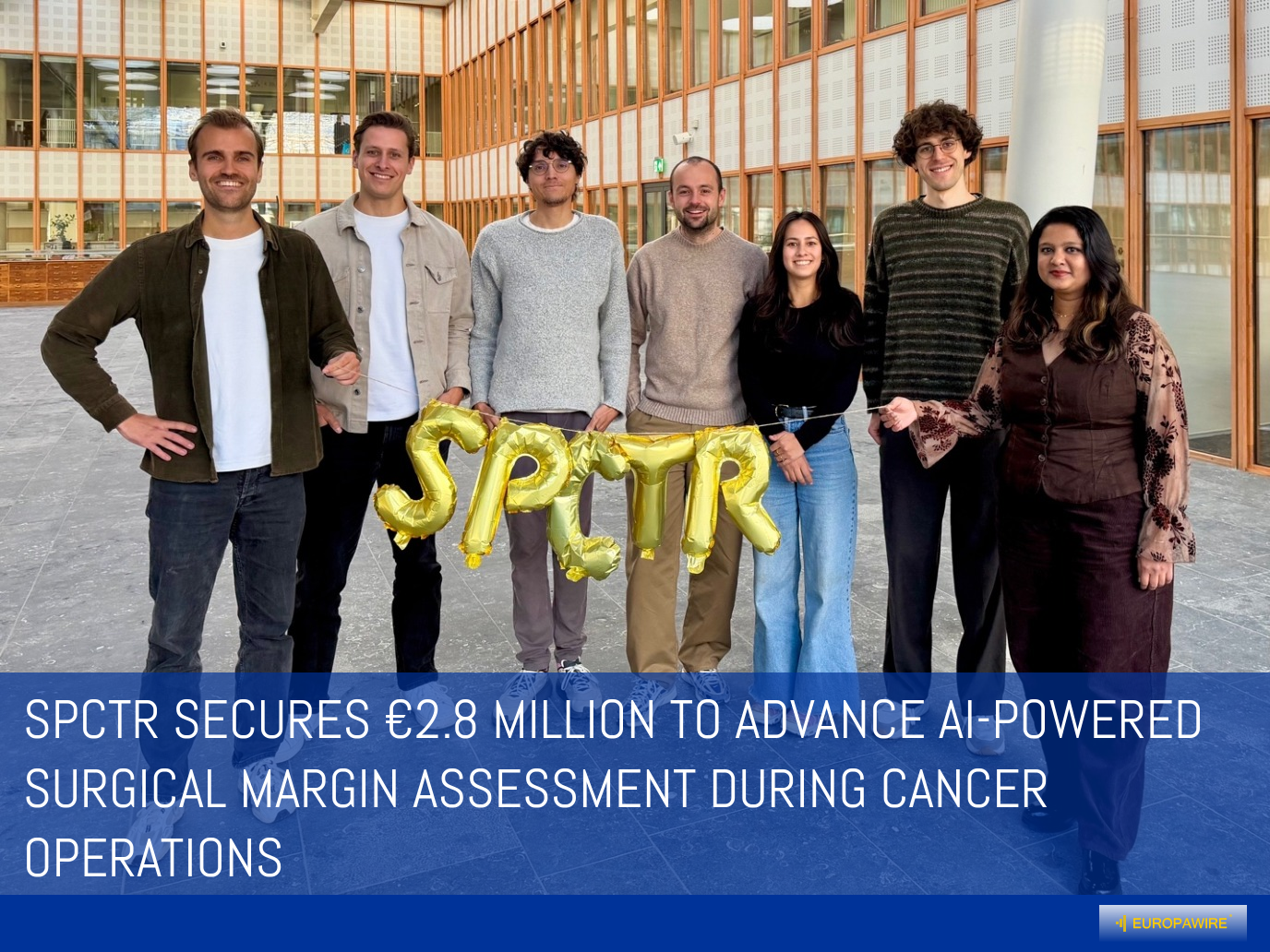
SPCTR, a Dutch medtech startup splitting its work between Utrecht and Groningen, has raised €2.8 million (about $3.1 million) in seed funding. The round, announced November 26, 2026, was led by health insurer VGZ's Voorop in Zorg fund, with Future Tech Ventures, regional investor NOM, a group of business angels and the European Just Transition Fund also participating, according to EuropaWire.
What problem is SPCTR trying to fix in the operating room?
When a surgeon removes a tumor, confirming the margins are clean — no cancer cells left at the edge of the cut tissue — usually means sending samples to a pathology lab and waiting days for results. If the margins come back unclear, the patient may need a second operation.
SPCTR built its device, called SPCTRone, to answer that question before the patient ever leaves the table, cutting out the days-long wait and the odds of a repeat surgery.
How does SPCTRone actually work, and has it been tested on real patients?
SPCTRone combines optical imaging with an AI model trained to spot cancerous tissue at the edge of a surgical margin, without requiring a contrast agent or a pathologist in the loop at that moment. The system flags unclear margins in real time so the surgeon can remove additional tissue immediately, during the same procedure.
Founded in 2025 with a team of eight, SPCTR has already scanned more than 200 patients at UMC Utrecht and the Academic Breast Center Groningen. A larger follow-up study is set to launch in late 2026 across three Dutch hospitals — Academic Breast Center Groningen, St. Antonius Hospital and Isala — pending ethics and hospital approvals, expanding from breast cancer toward other solid tumors.
What will the €2.8 million fund, and who's backing it?
SPCTR says the capital goes toward multicentre clinical testing and growing its small team. The investor mix is notable for putting VGZ, a Dutch health insurer, in the lead seat — a sign the technology's cost-saving pitch to the healthcare system, not just its clinical upside, is drawing capital. Future Tech Ventures' involvement includes RUG Ventures, the investment arm tied to the University of Groningen, linking the round back to the academic hospitals already running SPCTR's trials.
Who else works on margin assessment, and what comes next?
Existing alternatives include frozen-section pathology, which is slow, and electrical-impedance probes such as MarginProbe, which rely on a different sensing approach. SPCTR is betting that fusing optical imaging with AI gives surgeons a faster, more specific read without adding new hardware to manage mid-operation.
The company's next checkpoints are finishing the multicentre study, pursuing CE marking, and proving the approach generalizes beyond breast cancer to other solid tumors — the step that would turn SPCTR from a single-indication device into a platform.