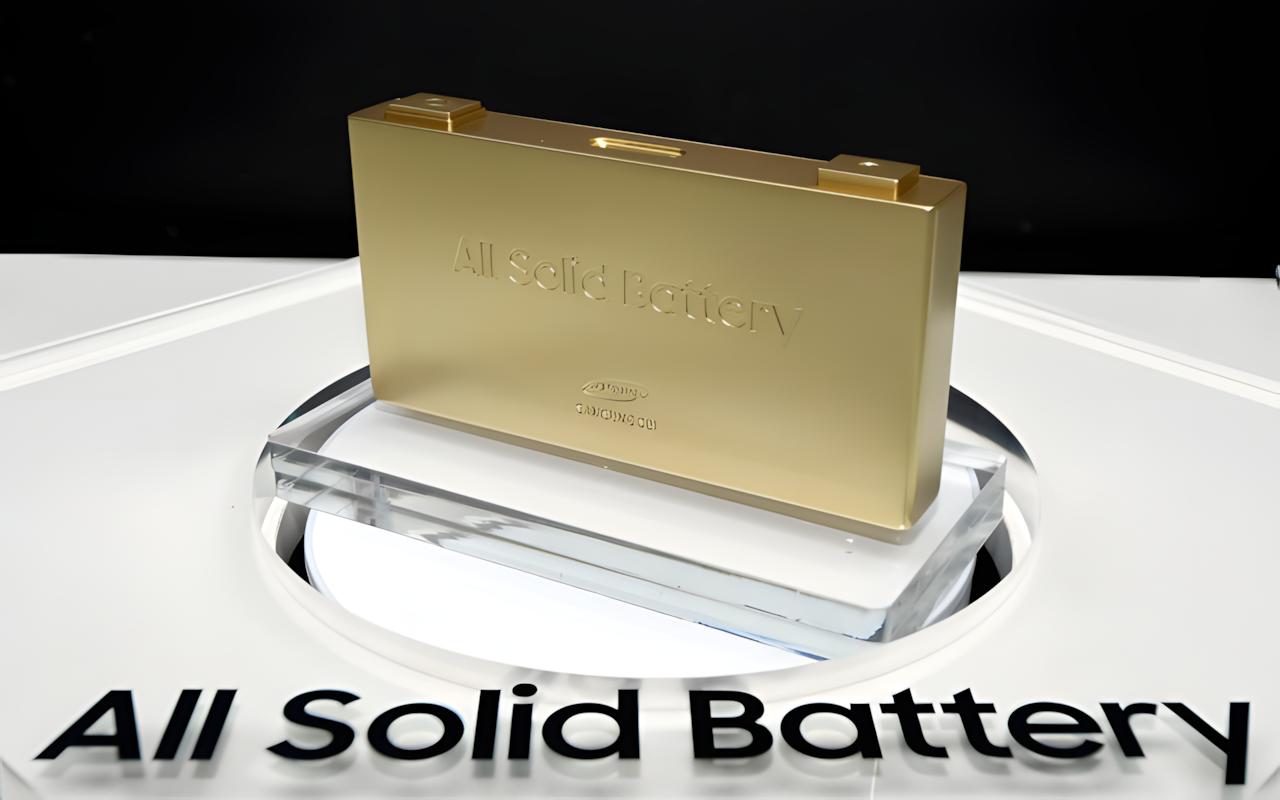
Samsung SDI has laid out the industry's most detailed roadmap yet for all-solid-state battery mass production, presenting an investment plan that commits 25 trillion won (approximately $17 billion) to its Ulsan and Cheonan facilities between 2026 and 2040 and targeting first commercial output in the second half of 2027. The disclosure, first reported in early August 2026 by Korean industry publications and translated by Battery-News on August 3, positions Samsung SDI to move sulfide-based solid electrolyte chemistry from pilot cells into a scaled production line before any global rival.
Where The Capital Lands
Of the 25 trillion won commitment, 16 trillion won is earmarked for the Ulsan plant in southeastern South Korea, where Samsung SDI will build new lines for three battery families in parallel: sulfide-based all-solid-state cells, lithium iron phosphate (LFP) cells for energy storage systems, and sodium-ion chemistry. A further 9 trillion won goes to Cheonan, which will act as the technology development and validation hub. The company has already stood up a 6,500-square-meter pilot line at its Suwon R&D center where multiple rounds of material and process qualification have been completed; the future Ulsan line will inherit the pilot's process recipe.
Sulfide Chemistry Targeting 900+ Wh/L
Samsung SDI has committed to sulfide-based solid electrolytes — the higher-conductivity chemistry family also being pursued by competitive Korean and Japanese cell makers — with a stated energy density target above 900 Wh/L. That is roughly a 40% uplift on today's best NMC liquid-electrolyte cells and would remove the leading safety failure mode of lithium-ion cells at the same time. Sample cells are already in the hands of prospective customers across electric vehicles, embodied AI and — significantly — humanoid robotics, which have emerged as a bespoke high-value opportunity for compact, safety-critical, high-density cells.

Humanoid Robots Move To The Front
The humanoid customer callout is not incidental. Samsung Electronics is separately pushing a group-wide humanoid strategy — the CEO-level RX Business Promotion Office established in July has explicitly designated Samsung SDI's next-generation solid-state cells as a "strong candidate" for the humanoid power source. Ulsan's mass line is being marketed inside Samsung Group as the world's first purpose-built solid-state battery gigafactory for humanoids and next-gen EVs, and government messaging from Seoul has framed the site as central to South Korea's 2028 humanoid commercialization target.
Roll-Out Sequencing
The company said commercialization will start on home turf before the process is transferred to overseas sites once scaling has been validated. That sequencing echoes Samsung SDI's LFP roadmap — first Ulsan, then North American joint ventures — and buys the company time to work through the sulfide chemistry's real-world moisture-sensitivity and stack-pressure quirks before it commits capital abroad.
Reporting based on coverage from Battery-News.de, TheElec, Gasgoo Auto News, and EnergyTrend.