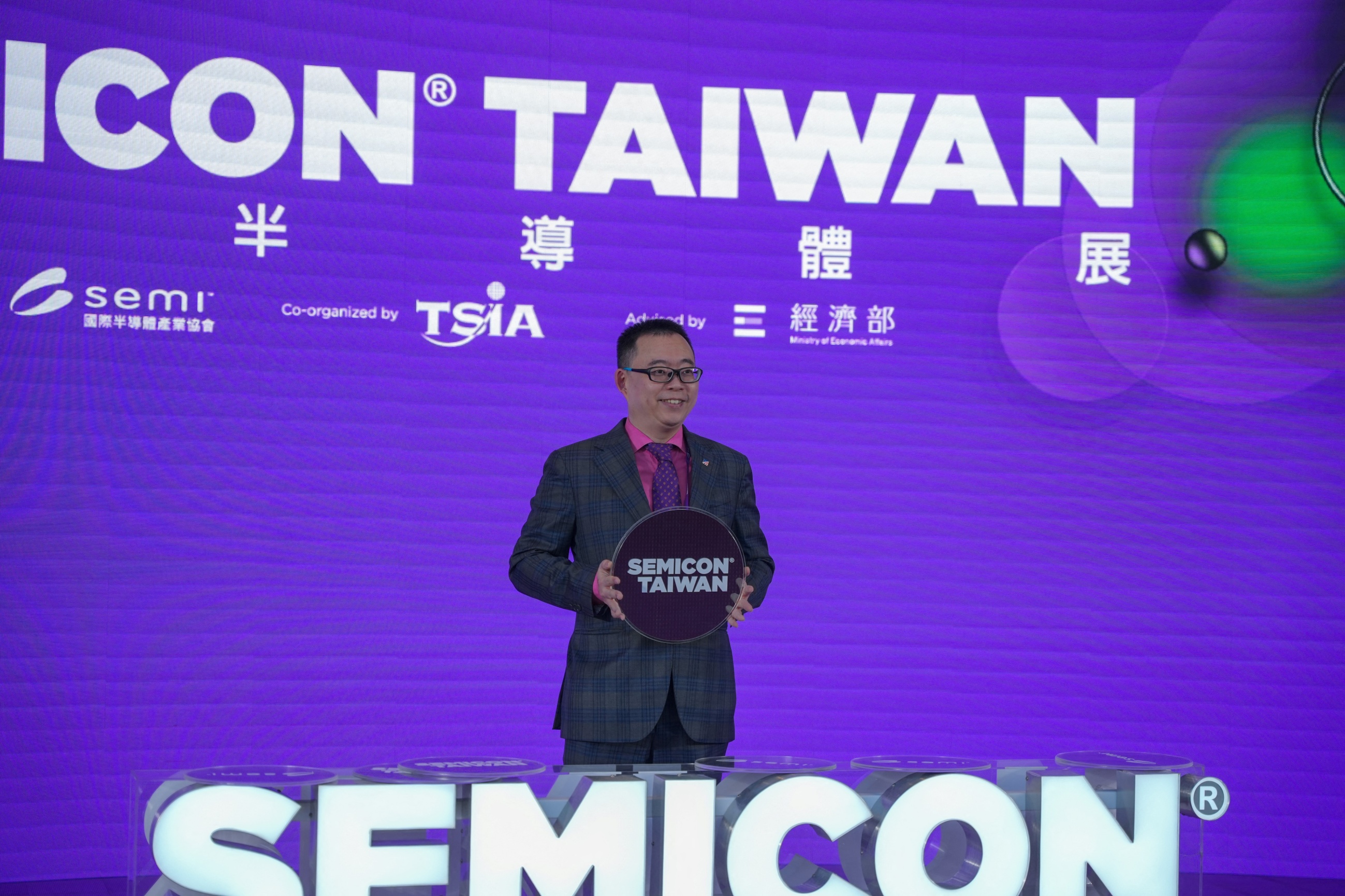
Semicon Taiwan 2026, the semiconductor industry's largest annual gathering in Asia, opened its International Semiconductor Week forums August 31 in Taipei and kicked off its main exhibition on Wednesday, September 2 at the Taipei Nangang Exhibition Center (TaiNEX). The record-setting edition runs through Friday, September 4 and draws more than 100,000 professionals from 65 countries.
Record scale, single engineering question
The 2026 event brings together more than 1,300 exhibitors, 4,300 booths and 18 national pavilions — every figure a fresh high, according to organiser SEMI. "Data movement in today's AI systems could consume more energy than computation itself, making system architecture, not individual chip performance, the new bottleneck," said Terry Tsao, SEMI's Global Chief Marketing Officer and Taiwan president. That framing has shaped the whole agenda: silicon photonics, high-bandwidth memory, heterogeneous integration and advanced packaging are not parallel tracks but different engineering responses to the same widening gap between how fast chips compute and how fast data can move between them.

Silicon Photonics Global Summit debut
The first standalone Silicon Photonics Global Summit in Semicon Taiwan's history opened Monday morning as SEMI's designated flagship event for the interconnect transition. Co-packaged optics (CPO) — the discipline of moving optical engines inside a switch package — has moved from roadmap to production in 2026: TSMC's Compact Universal Photonic Engine (COUPE) platform entered mass production, UMC completed its first mass-produced silicon photonics wafers in Singapore with Silith Technology, and Foxconn expects to begin CPO switch shipments in the third quarter. GlobalWafers has entered volume production for some silicon photonics products earlier this year, while ShunSin has achieved mass-production capability for 51.2- and 102.4-terabit CPO products through a TSMC collaboration.
Memory Executive Summit and the AI memory wall
On Tuesday's Memory Executive Summit, executives from Samsung Electronics, SK hynix, Micron Technology, Sandisk and Solidigm shared a stage with Alphabet's Nikhil Cherian, whose opening keynote laid out Google's hardware-software playbook for breaking the AI memory wall. Global semiconductor revenues are expected to approach $975 billion in 2026, with memory alone projected to exceed $440 billion. SEMI separately projects 300mm fab equipment spending will reach $133 billion in 2026 and $151 billion in 2027 — the first time the industry will cross the $150 billion threshold in a single year.
Full-day CEO Summit and a first-ever Cybersecurity Summit
For the first time in the show's history, Wednesday's flagship executive gathering ran as a full-day CEO and Ecosystem Executive Summit under the theme Ecosystem × AI × Semiconductor to Transform Tomorrow. Google Senior Vice President Amin Vahdat delivered the opening keynote — his first public keynote address in Asia. The afternoon lineup drew Microsoft's Rani Borkar, Micron Technology's Manish Bhatia, Broadcom's Dr. Asad Khamisy, Meta's Dr. CQ Tang and NVIDIA's Michael Kagan. The week closes Friday with the inaugural Semiconductor Cybersecurity Global Summit, elevated to summit level in 2026 alongside the recurring Heterogeneous Integration Global Summit, Quantum Taiwan Forum and Strategic Materials Conference. The show also arrives days after Europe's Quobly, TNO and OrangeQS unveiled a silicon spin-qubit manufacturing partnership and Taiwan's Enflame Technology completed its 6,000x-oversubscribed Shanghai IPO, underscoring how quickly capital is flowing to advanced-node AI silicon.
Reporting based on coverage from Tech Times, EE Times Asia, Focus Taiwan, Taipei Times and SEMI press materials.