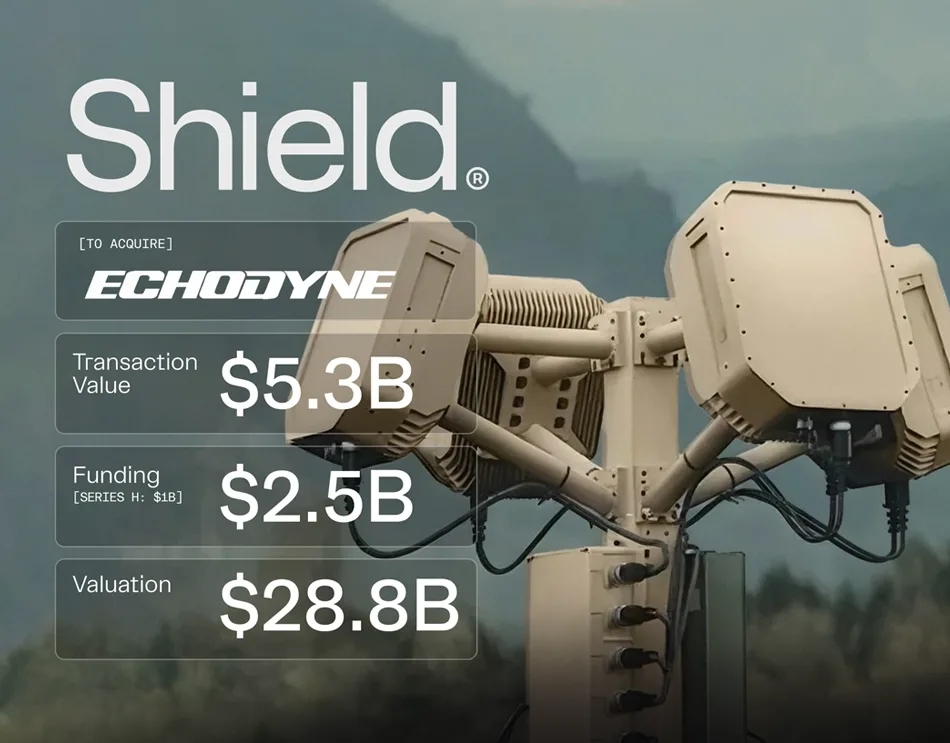
Shield AI announced on November 5 that it will acquire radar maker Echodyne in a deal valued at up to $5.3 billion, with $4.8 billion paid at closing and up to $500 million more tied to performance milestones. To fund the purchase, Shield AI is raising $2.5 billion: a $1 billion Series H round at a $28.8 billion post-money valuation, a $1 billion structured equity investment from Blackstone, and $500 million in debt financing arranged by JPMorgan Chase. The deal is expected to close in early 2027.
Echodyne, based in Kirkland, Washington, makes compact radars used for counter-drone defense and security across more than 40 countries. The company recently opened an 86,350-square-foot manufacturing facility, a $40 million investment capable of producing roughly 30,000 radars a year.
Why a drone-autonomy company wants a radar factory
Shield AI built its name on autonomy software and uncrewed aircraft like the V-BAT and the newly unveiled X-BAT combat drone. Buying Echodyne adds a third leg: mission systems, specifically the sensors that detect and track other drones. CEO Gary Steele said the deal "dramatically accelerates" Shield's ability to meet demand for multi-mission capability and opens the door to the broader counter-drone market, where customers increasingly want sensing and shooting bundled into one system rather than stitched together from separate vendors.
Echodyne CEO Eben Frankenberg framed the logic from the sensor side: "Superior sensors lead to superior systems and outcomes," he said, arguing that joining a larger company gives Echodyne the scale to serve defense, government and commercial customers globally rather than as a standalone radar supplier competing for the same contracts as its own customers' primes.
Consolidation in a crowded counter-drone market
The deal lands as militaries worldwide scramble to field cheap, effective defenses against small drones, a problem exposed repeatedly in Ukraine and increasingly visible over Western bases and borders. Rather than build radar in-house or license it, Shield AI is buying proven hardware and an existing customer base, a faster route than a multi-year internal program. It mirrors a pattern across defense tech, where fast-growing autonomy firms are absorbing hardware specialists to offer complete systems rather than software alone.
The financing structure is notable on its own: raising $2.5 billion, split across equity and debt, to fund a $5.3 billion acquisition values Shield AI itself at $28.8 billion, among the highest marks for a privately held defense-tech company. Whether the combined company can integrate Echodyne's manufacturing-heavy radar business with Shield's software-first culture, without the margin dilution that often accompanies hardware acquisitions, is the question investors will watch most closely once the deal closes.