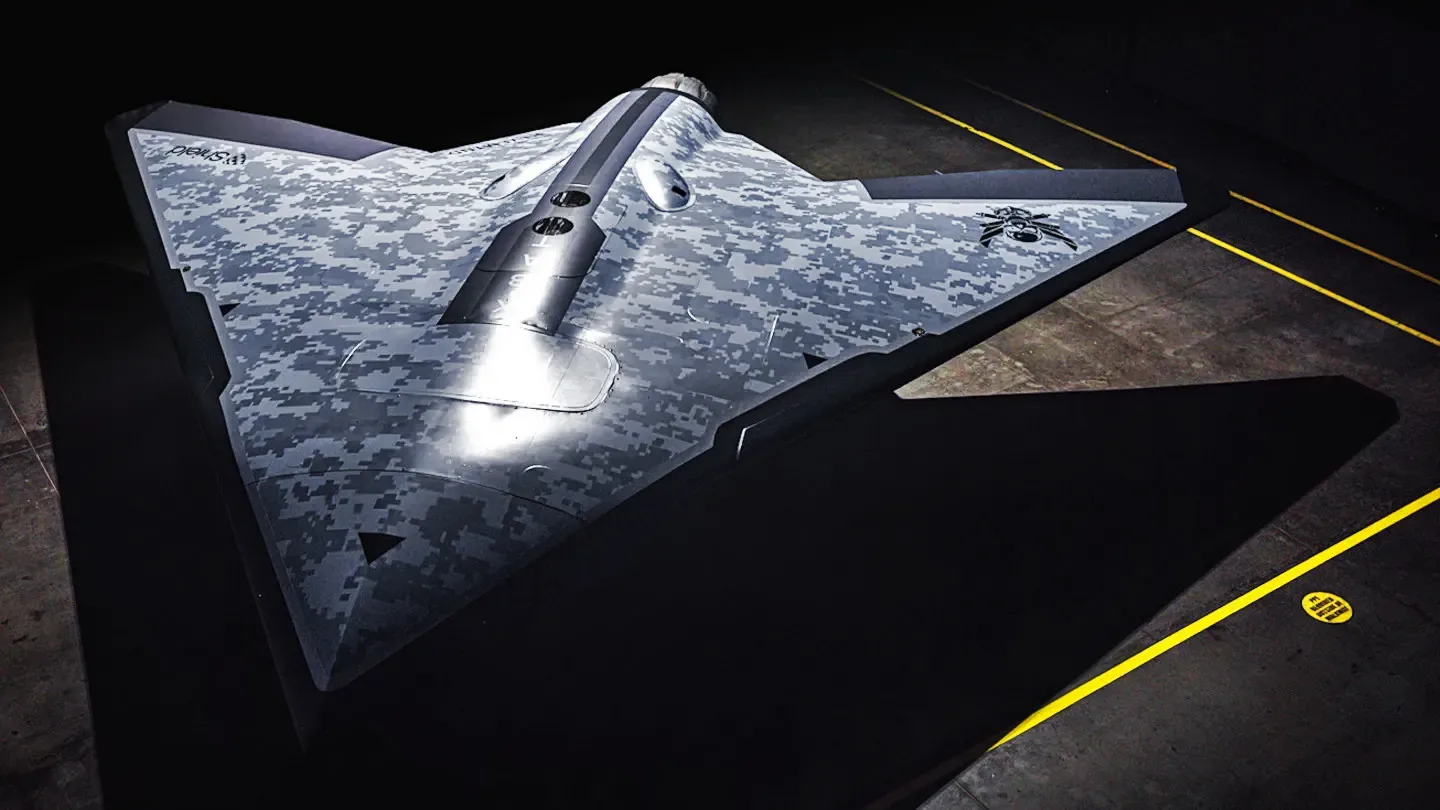
Shield AI has completed assembly of X-BAT 001, the first full-scale prototype of its jet-powered, tail-sitting vertical-takeoff-and-landing combat drone, according to The War Zone, which reported the reveal from video Shield AI released on November 3, 2026. The aircraft is moving from Shield AI's assembly site in Frisco, Texas, which the company calls X-Forge 1, to its flight-test facility in Newton, Kansas, where ground runs will precede the drone's first untethered flight.
X-BAT is built around a General Electric F110 jet engine and uses an Axisymmetric Vectoring Exhaust Nozzle for pitch and yaw control during hover, letting it take off and land vertically on its tail without a runway, catapult or arrestor gear. Shield AI says the airframe is roughly twice the size of the Air Force's Increment 1 Collaborative Combat Aircraft and, unlike those smaller drones, carries an internal weapons bay plus external wing hardpoints sized for both air-to-air and air-to-ground missions. The company targets a first flight before the end of 2026, fully missionized flight by 2028 and the start of series production in 2029.
Why Runway Independence Matters
Shield AI's primary customer for X-BAT is the U.S. Navy, through its Runway Independent Maritime Expeditionary Strike program, which put $200 million behind the effort in 2026 with Shield AI matching that investment. The pitch is straightforward: a combat drone that needs neither an aircraft carrier nor a paved runway can fly from austere locations, including damaged airfields or small ships, which matters directly to Pacific war planning as the Pentagon has grown concerned that fixed runways and carrier decks present easy, high-value targets. Shield AI SVP Armor Harris has described the approach as enabling land-based "shoot-and-scoot" tactics, where the aircraft disperses to avoid presenting a concentrated target rather than operating from a handful of defended bases.
Internal weapons carriage distinguishes X-BAT from smaller loyal-wingman drones built mainly for air-to-air missions. Stowing munitions inside the airframe instead of on exposed external pylons reduces radar cross-section and lets the aircraft fly closer to contested airspace, at the cost of a larger, heavier airframe than drones optimized purely for cheap, attritable air-to-air duty.
A Crowded Field of Autonomous Combat Aircraft
X-BAT enters a competitive landscape where General Atomics is pursuing a hybrid-electric strike-reconnaissance flying wing under its own NextGen program, and the Air Force's Increment 1 effort already has General Atomics and Anduril competing on smaller, air-to-air-focused Collaborative Combat Aircraft. Shield AI's bet is that runway independence and a larger payload, not low unit cost, is the differentiator that wins Navy contracts, even though that approach requires a more complex vertical-landing airframe than a conventional runway-launched drone.
The approach carries real technical risk. Tail-sitting VTOL aircraft are notoriously difficult to control during the transition between hover and forward flight, a challenge that has stalled or killed several prior military VTOL drone programs. Shield AI's staged flight-test plan, moving from horizontal engine runs to vertical runs to crane-suspended tests before attempting an untethered flight, reflects how much the company still needs to prove before X-BAT can be trusted with the 2028 missionized-flight target it has set for itself. A slip in that schedule would also delay the 2029 production start the Navy is counting on to field the aircraft at scale.
Shield AI has built its reputation on autonomy software rather than airframes, powering its Hivemind AI stack across platforms including the V-BAT drone and, more recently, a partnership with Leonardo to fly autonomous helicopter missions. X-BAT marks the company's most ambitious hardware program yet, betting that the software advantage it has sold to smaller drone operators can scale to a fighter-sized combat aircraft the Navy is willing to fund through full production.