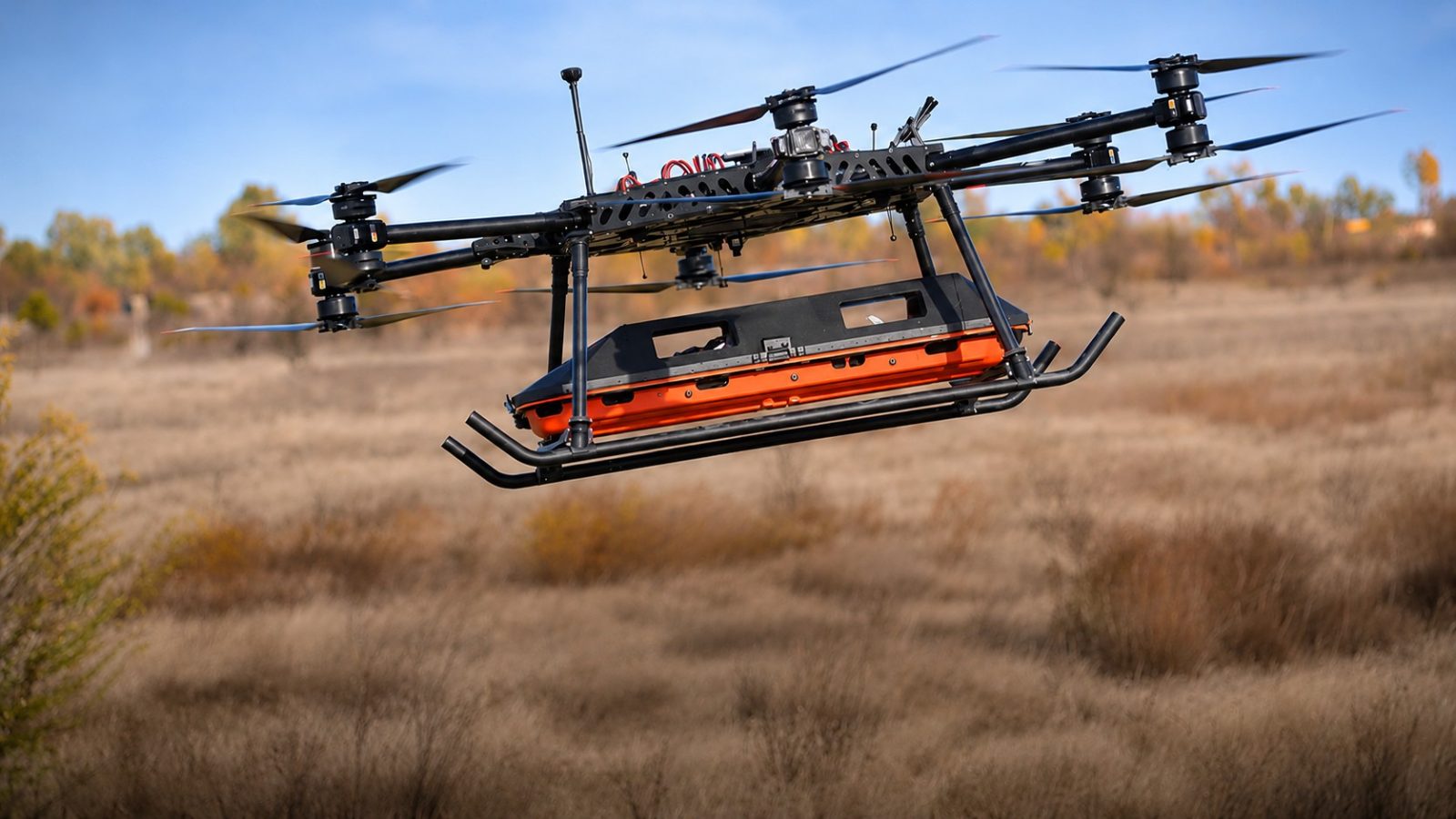
Ukraine has carried out what military officials describe as the world's first medical evacuations of wounded soldiers using heavy uncrewed aircraft, lifting troops out of positions that ground vehicles could not safely reach. The first rescue came in October 2026, when a Heavy Shot Ayudag-6 hexacopter extracted a wounded infantryman from the 30th Separate Mechanised Brigade out of a position the enemy had effectively blocked off from ground approach.
The Ayudag-6, built by a participant in Ukraine's Brave1 defense-tech platform, weighs 98 kilograms and carries a payload capacity of 130 kilograms — enough for a wounded soldier and basic equipment. It has demonstrated a range of more than 15 kilometers in testing. A second heavy-lift system, called Stargate, has since flown medevac missions for the 475th Assault Regiment's CODE 9.2 unit, carrying up to 150 kilograms at speeds up to 105 km/h, deploying within 10 minutes of a call, and covering roughly 30 kilometers each way with an integrated stretcher module, AI-assisted navigation and electronic-warfare resilience built in.
Why ground evacuation stopped being an option
The shift to aerial evacuation isn't a technology experiment so much as a response to how the front line now operates. Dense coverage from reconnaissance and strike drones on both sides has made conventional vehicle-based casualty evacuation close to impossible along much of the front, turning routine medevac runs into high-casualty missions of their own. Brave1 set formal technical requirements for evacuation drones back in 2024 — a minimum payload of 130 kilograms, a minimum range of 15 kilometers, at least three redundant communication links, and resistance to jamming through LiDAR-based and optical stabilization plus satellite-independent navigation — well before the first operational rescue flew. That two-year gap between requirement and fielded capability says as much about the difficulty of the engineering as about bureaucratic speed.
A fast-scaling category inside Ukraine's drone industry
Ukraine's Defense Procurement Agency says contracts for uncrewed systems have roughly tripled in 2026 compared with the prior year, and heavy-lift medevac drones represent one of the newer, higher-value categories inside that growth. Unlike the small FPV strike drones that have dominated headlines from the war, systems like the Ayudag-6 and Stargate sit closer in scale and cost to small helicopters, and they compete directly with the amphibious and wheeled logistics UGVs Ukraine has also fielded for frontline resupply and evacuation over the past year.
Two confirmed evacuations don't yet make heavy-lift medevac drones a reliable battlefield capability, and officials have acknowledged the program is still being developed as a dedicated specialty rather than treated as fully operational. But the economics favor expansion: a drone capable of flying a 30-kilometer round trip in under an hour, without exposing a ground crew to the strike-drone density that now blankets much of the contact line, is a difficult capability for commanders to ignore once it exists. Expect other militaries watching the war closely, including NATO members developing their own ground and aerial logistics robots, to study how quickly Ukraine scales this specific capability from two missions to a standing fleet.
Details were first reported by the UK Defence Journal.