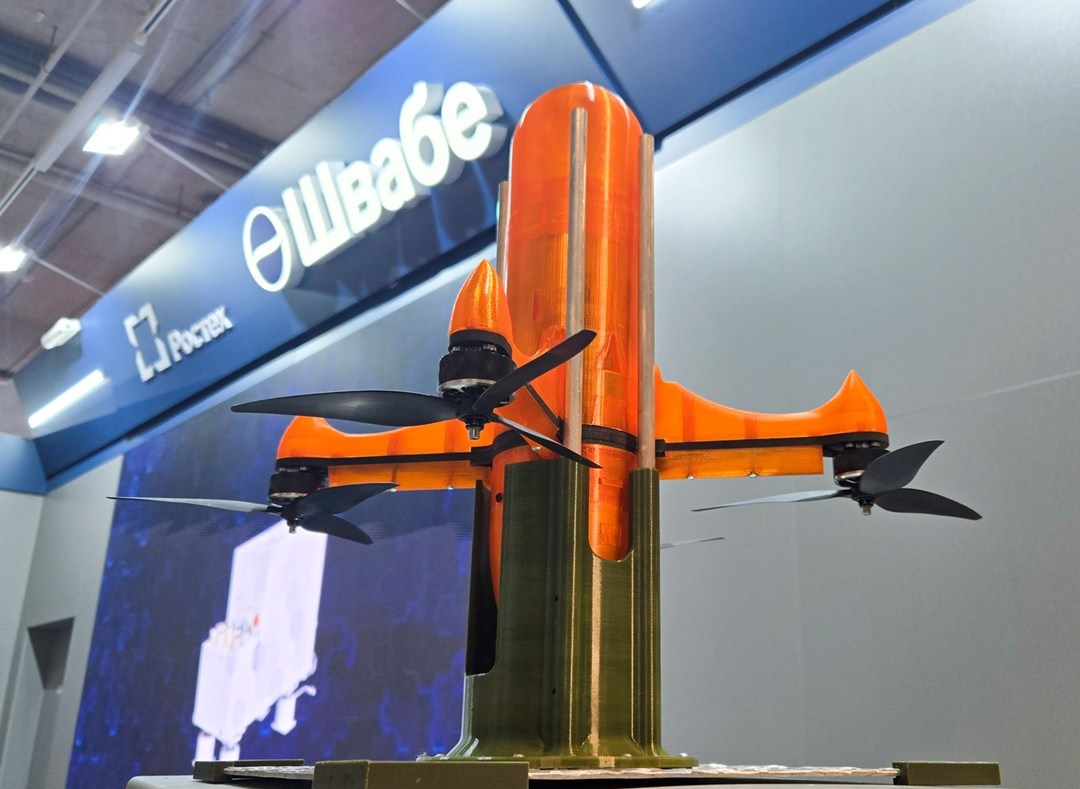
Russian state-owned defense group Shvabe Holding has unveiled a neural network-guided counter-drone interceptor system for coastal and maritime defense at the Fleet 2026 International Maritime Defence Show in Kronstadt, near St. Petersburg.
An AI-guided coastal interceptor
The system, presented on June 10, 2026 by the Rostec optoelectronics subsidiary, consists of three core components: a ground-based optical-electronic surveillance station that continuously monitors a protected area, an operator workstation that fuses threat data, and a fleet of interceptor drones that close the engagement. According to Shvabe, AI guides the interceptor autonomously through the terminal phase after a human operator authorises launch.
Targeting low-speed aerial and surface drones
The platform is designed against low-speed aerial drones and surface unmanned vessels, the same threat class repeatedly used in Ukrainian long-range strikes on Russia's Black Sea Fleet and—most recently—at Kronstadt itself. By coupling continuous EO surveillance with autonomous interceptors, Shvabe is positioning the system as a fast-reaction layer that complements traditional point-defense guns and short-range missile systems.

Russia's accelerating counter-USV push
Fleet 2026, which runs June 10–14 at Kronstadt, has become Russia's annual showcase for unmanned naval systems and counter-drone tools. Shvabe's reveal lands alongside a wave of Western activity, including Saronic's Marauder MUSV, HII's ROMULUS USV and Senate language empowering the U.S. Army on counter-UAS standards.
From mock-up to fielded system
For now the Shvabe unit shown at Fleet 2026 is a mock-up; Russian press said the holding is working with Rostec on serial production timelines and on integrating the interceptors with existing Russian Navy command-and-control networks. If fielded at scale, the system would mark one of Russia's first openly disclosed AI-guided naval defence platforms.
Reporting based on coverage from TASS, Defense Mirror, defence-blog.com and Army Recognition.