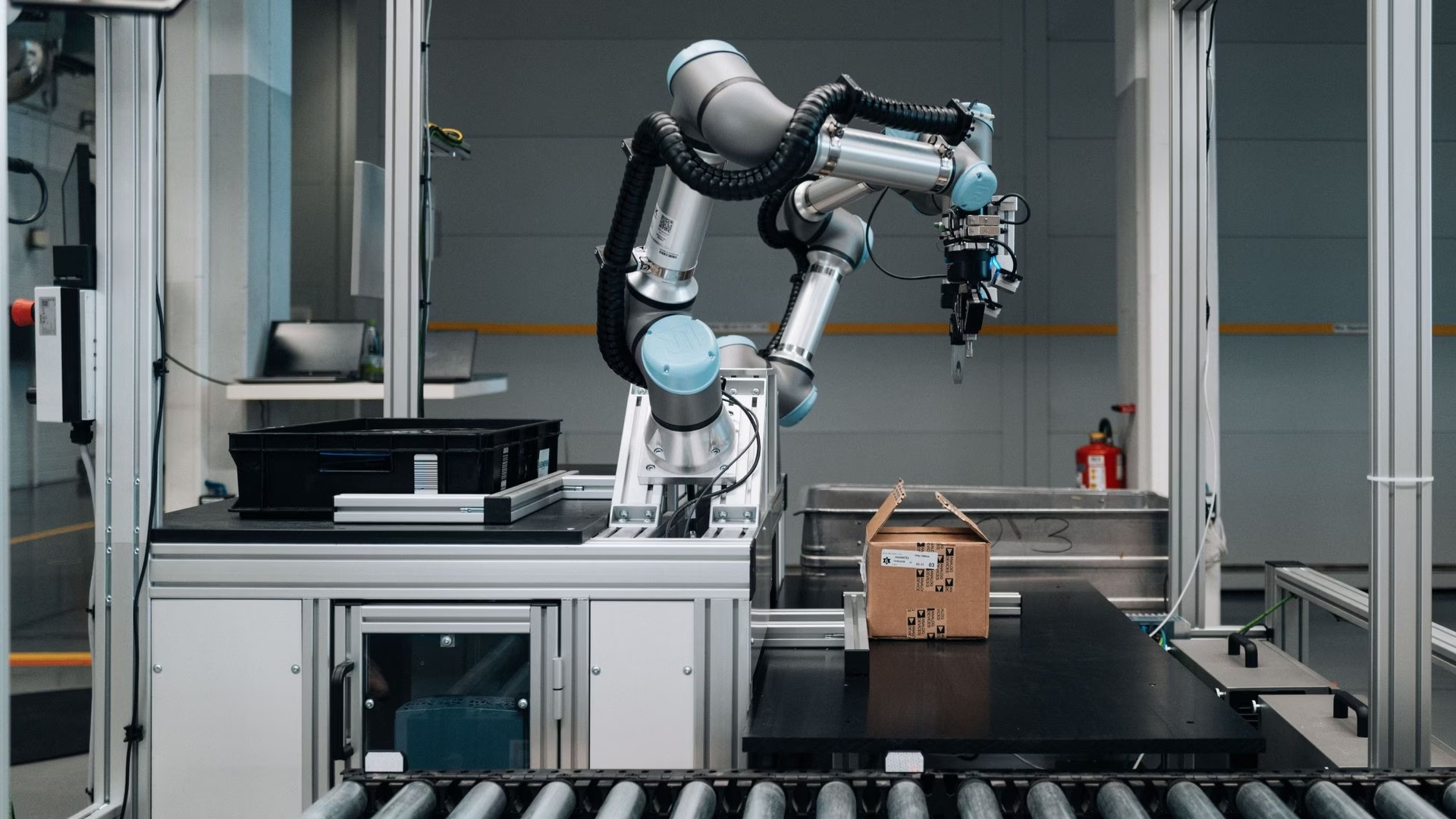
Siemens used the SPS 2026 automation fair in Nuremberg, running November 24-26, to show two pieces of its industrial AI push: a prototype robot that opens incoming delivery boxes on its own, and a planning tool it says can cut manual production scheduling effort by 70 percent.
The unpacking robot is being developed at Siemens' Electronics Factory in Erlangen, Germany, where incoming parts shipments vary so widely in box type and size that fixed robot programs can't handle them. That variability has kept unpacking a manual job even as other factory steps got automated.
How does the unpacking robot actually work?
Cameras capture the workspace in real time, and a robot foundation model, an AI system trained for physical tasks rather than text or images, interprets what it sees and decides the next action. The robot then opens the carton and removes the component reels inside for further processing. Siemens trained the model on data from people remotely steering the robot through the task, a method known as teleoperation-based learning, and the system runs on Siemens industrial PCs equipped with Nvidia chips.
Siemens has not set a date for when the robot will be ready for production use. The company presented it at SPS 2026 as work in progress rather than a shipping product, according to The Next Web.
What is the Autonomous Production Planner, and why does it matter?
The second announcement is the Autonomous Production Planner, a new module inside Siemens' Intelligence Center X software platform, which orchestrates the company's industrial AI tools. Multiple AI agents work together to generate production schedules and optimize them against a factory's chosen performance targets. Each schedule then runs through a physics-based digital twin for validation before it is released to the shop floor.
Siemens says the tool can cut manual planning effort by 70 percent and lower associated costs by up to 20 percent. Rainer Brehm, president of automation at Siemens, framed the push in blunt terms: \"The next productivity leap will come from automating tasks that were impossible to automate before,\" he said, according to Automation World.
How does this fit into the broader robot foundation model race?
Siemens is effectively betting that the next wave of factory automation depends less on faster robot arms and more on software that lets existing hardware handle tasks nobody could program in advance, chiefly unstructured material handling like unpacking, sorting and kitting. That puts Siemens in the same race as companies building general-purpose robot \"brains,\" a category that has drawn billions in funding over the past year as both industrial giants and startups chase the same underlying problem: getting a robot to generalize beyond a narrow, pre-programmed task.
Siemens also used SPS 2026 to extend its Eigen Engineering Agent, an AI tool integrated with its TIA Portal engineering software, into the process industry through a new link with SIMATIC PCS 7. Eigen first launched in April 2026 to help factory automation engineers adapt code; the expansion signals Siemens is pushing the same agentic approach from discrete manufacturing into continuous-process plants like chemical and pharmaceutical production.
What happens next?
Siemens did not commit to a commercial rollout date for either the unpacking robot or the Autonomous Production Planner, and executives have not disclosed pricing. The company is also preparing its automation portfolio for the EU Cyber Resilience Act, which takes effect December 11, 2027, suggesting these tools will need to clear new security requirements before wide deployment. For now, Erlangen functions as the proving ground where Siemens will refine the unpacking system before deciding whether to offer it to outside customers.