Marc Raibert left Boston Dynamics in 2022 to start something smaller and stranger: a research lab with no product roadmap, bankrolled by $400 million from the very company that had just bought the robot maker he founded. On November 24, 2026, that lab changed hands again. SoftBank confirmed it has completed its acquisition of the Robotics and AI Institute (RAI) from Hyundai Motor Group, according to The Robot Report.
Financial terms were not disclosed, and SoftBank declined to answer questions about the price or its plans for the institute's research direction. RAI operates out of Cambridge, Massachusetts, with a second office in Zurich, Switzerland, and currently lists 24 open positions spanning mobility, manipulation, perception and machine intelligence research.
A Deal That Runs in the Opposite Direction
The transaction closes a loop that started when SoftBank sold its controlling stake in Boston Dynamics to Hyundai in 2021, a deal that valued the robot maker at roughly $1.1 billion and ended SoftBank's ownership run. Raibert, who founded Boston Dynamics in 1992 and stayed on as chairman after the sale, used fresh Hyundai capital to launch RAI as an independent, product-agnostic research lab in 2022.
Hyundai's exit from RAI comes almost immediately after it moved in the opposite direction with Boston Dynamics itself. The automaker recently exercised a settlement on a put option to absorb SoftBank's remaining 9.65% stake in Boston Dynamics, making the robot maker a wholly owned subsidiary for the first time since the 2021 ownership split. In effect, the two companies traded assets: Hyundai consolidated full control of the commercial robot business, while SoftBank took over the pure-research arm built around Raibert's name.
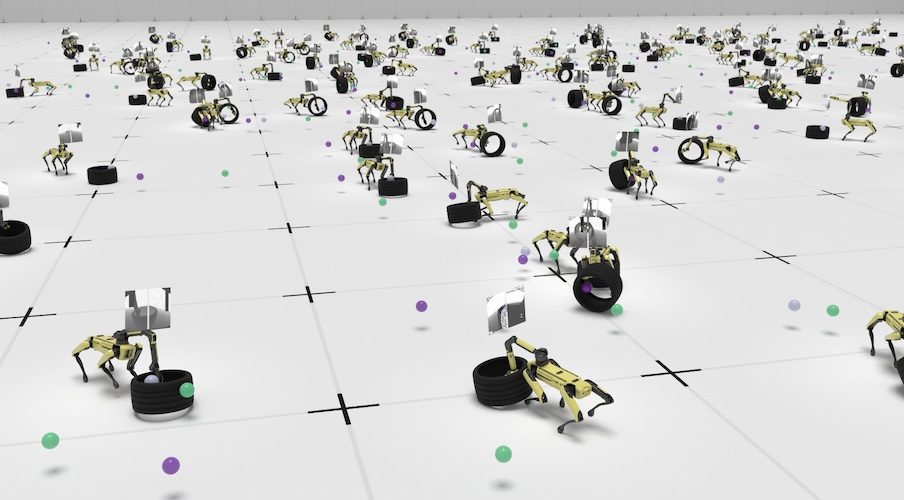
RAI's mandate has always been distinct from Boston Dynamics' product lines. Rather than shipping robots like Spot or Atlas, the institute studies foundational problems in locomotion, dexterous manipulation and perception meant to feed robotics broadly, not a single company's catalog. That framing matters to SoftBank, which has spent the past two years assembling a sprawling robotics portfolio that includes 1X Technologies, Agile Robots, AutoStore, BALYO, Berkshire Grey, Brain Corp, Skild AI and Symbotic.
Why SoftBank Wants a Research Lab, Not Just Robots
Owning RAI gives SoftBank direct access to a team built specifically around open-ended robotics research rather than a single commercial product, at a moment when rivals race to build general-purpose foundation models for physical tasks. Nvidia, Google DeepMind and a wave of well-funded startups are each pursuing versions of the same goal: software that lets a robot learn new skills without being rebuilt for each one. SoftBank has described robotics and artificial intelligence as inseparable bets, and RAI's roster of specialists in mobility and manipulation slots directly into that thesis.
It remains unclear whether SoftBank will change RAI's research priorities or let it continue operating with the independence it had under Hyundai. The institute's 24 open roles, spread across its US and Swiss offices, suggest hiring has not paused during the ownership transition. For an industry watching SoftBank assemble pieces of a robotics empire — hardware through Agile Robots, warehouse automation through Berkshire Grey and Symbotic, and now foundational research through RAI — the acquisition reads less like a single deal and more like the latest placement in a larger wager on physical AI.