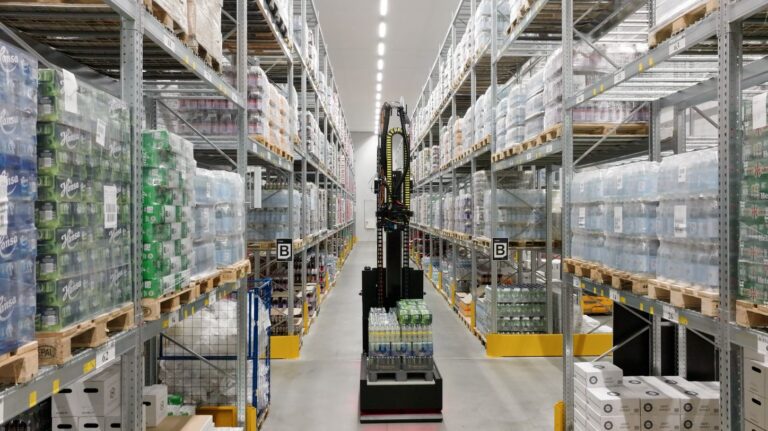
Witron, the German warehouse automation group best known for building large, fixed conveyor and crane systems for grocery distribution centers, has acquired Norwegian startup Solwr Robotics, marking its first entry into autonomous mobile robots. Terms of the deal were not disclosed.
What does Witron actually get from this deal?
Two products: Grab, an autonomous robot that picks and palletizes cases weighing up to 30 kilograms across ambient, chilled and frozen-food zones; and Sort, an empty pallet sorter that runs at a standard throughput of 300 pallets an hour, scalable to more than 600. Both robots navigate warehouse aisles on their own and are designed to work alongside human staff rather than behind cages.
Solwr, founded in 2016 and based in Ålesund, Norway, employs about 50 people across sites in Ålesund, Trondheim, Oslo and Gothenburg. Notably, Solwr Software AS — the company's separate software arm — is excluded from the acquisition, meaning Witron bought the hardware and robotics team rather than the full business.
Who already uses these robots, and why does that matter?
Scandinavian grocery chains ASKO and COOP run Solwr's systems today, alongside UK wholesaler James Hall & Co. That customer list matters because it sits squarely in Witron's core market: high-volume grocery and retail distribution, where case-level picking accuracy and cold-chain reliability decide whether a contract renews.
Those existing accounts give Witron a working reference base rather than a lab prototype, which typically speeds up sales conversations with risk-averse logistics buyers who want proof before signing a multi-year automation contract.
Why is an automation giant buying instead of building its own robots?
Witron's traditional business model relies on large, custom-engineered systems that take months to install and are difficult to retrofit once built. Mobile robots like Grab and Sort can be added to a warehouse incrementally, letting Witron compete for mid-sized facilities or phased expansions that don't justify a full fixed-automation overhaul. Christian Mattes, Witron's innovation manager, said the deal "will open doors to new industries and markets."
The move mirrors a broader consolidation pattern in warehouse robotics this year, as established automation suppliers acquire specialist mobile-robot makers rather than build competing fleets from scratch. Rockwell Automation struck a similar deal for AGILOX's forklift-style robots in 2026, while Locus Robotics and Geek+ continue expanding their own case-picking fleets independently — all chasing the same grocery and retail accounts Witron can now bid for with in-house robots instead of outside partners.
What happens to Solwr now, and what comes next?
Solwr keeps its existing management team and all four of its Norwegian and Swedish office locations, according to Logistics Manager. The Grab and Sort technology can either be physically integrated into Witron's existing conveyor and crane systems or sold as standalone robots running on other companies' warehouse management software.
That flexibility lets Witron pursue two sales paths at once: bundling the robots into new large-scale installations, or selling them separately to warehouses that already run a different automation vendor's software. For a 50-person Norwegian startup, being folded into one of Europe's largest warehouse automation suppliers means a much faster route to the multi-site grocery contracts it could not win alone.