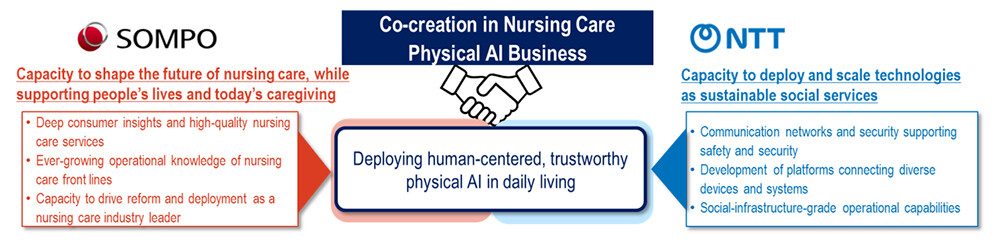
Sompo Holdings and NTT signed a partnership agreement on November 11 to bring physical AI into Japan's nursing care sector, targeting the chronic staffing shortages that have strained elder care facilities across the country. The deal pairs Sompo's operational knowledge of nursing care sites with NTT's networking and platform infrastructure, aiming to move physical AI deployments from pilot demonstrations toward actual commercialization.
The two companies define physical AI as systems that read the state of a physical space through cameras and sensors, then act on that information through robots or other equipment. Rather than starting with direct patient care — the most sensitive and highest-stakes category of work — the partnership's initial focus is indirect operations: cleaning, laundry, meal preparation and clearing, and moving items around facilities.
Why Japan is the proving ground
Japan's nursing care workforce has been shrinking for years against a rapidly aging population, a mismatch that has made the sector one of the most closely watched test beds globally for whether service robots can meaningfully offset labor gaps rather than just supplement them. Sompo, one of Japan's largest insurers with a sprawling nursing care business, brings direct visibility into which tasks actually burden staff and where automation would free up the most time. NTT contributes the harder-to-see layer: secure networks, device management platforms and the kind of infrastructure-grade reliability that turns a robot from a lab demonstration into something that keeps working on a hospital floor or care home for years.
Under the agreement, the companies plan to identify priority use cases directly from nursing care front lines, then build operational models that treat physical AI and human staff as collaborators rather than a straight replacement. That framing echoes a broader pattern in hospital and elder-care robotics, where successful deployments tend to automate narrow, repetitive tasks and leave direct human interaction to staff.
No hardware yet, but a clear roadmap
Sompo Holdings CEO Mikio Okumura and NTT President Akira Shimada signed off on the agreement, but neither company has named specific robot models, vendors or a deployment date. The next step, per the companies, is substantiating target use cases and building implementation frameworks for safe, sustained use — meaning this is a framework agreement rather than an announcement of robots already on care-home floors.
That caution fits a sector where safety failures carry outsized reputational and regulatory risk. Still, the partnership adds two heavyweight Japanese corporations to a growing list of insurers, telecoms and industrial groups treating physical AI in elder care as a near-term commercial opportunity rather than a distant research bet, according to NTT.