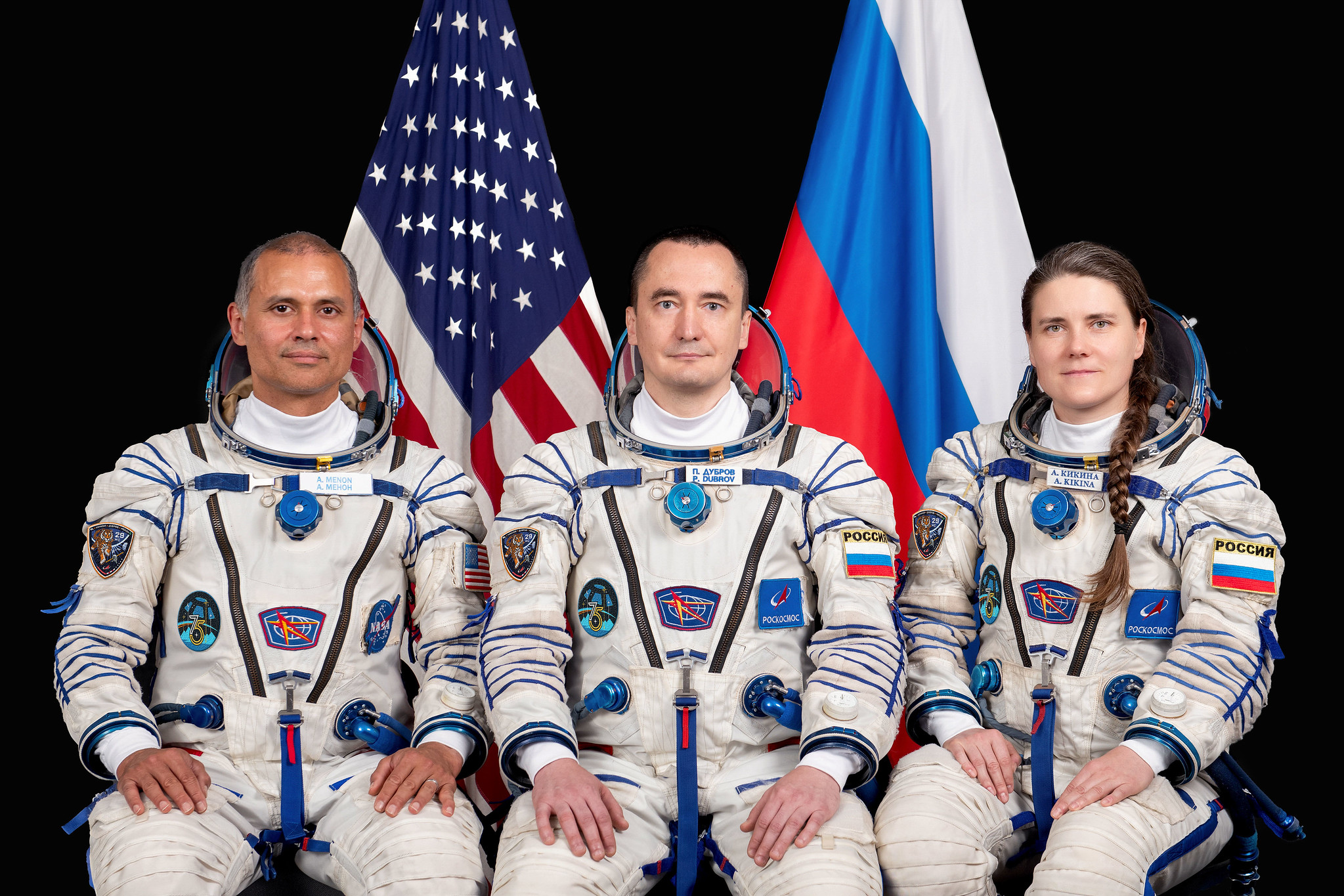
NASA's Anil Menon Rides Soyuz MS-29 to ISS With Dubrov and Kikina
NASA astronaut Anil Menon and Roscosmos cosmonauts Pyotr Dubrov and Anna Kikina launched aboard Soyuz MS-29 from Baikonur on July 14, 2026 for an eight-month Expedition 74/75 rotation on the International Space Station.
Key Takeaways
NASA astronaut Anil Menon launched aboard Soyuz MS-29 from Baikonur Cosmodrome at 10:47 a.m. EDT on July 14, 2026, with Roscosmos cosmonauts Pyotr Dubrov and Anna Kikina for an eight-month ISS mission.
The Soyuz was set for a two-orbit, three-hour rendezvous, docking automatically to the ISS Prichal module at 1:56 p.m. EDT, with hatch opening at 3:55 p.m.
It is Menon's first spaceflight after his selection in NASA's 2021 astronaut Group 23; the crew joins Expeditions 74/75 and is due to return to Earth in April 2027.
Menon's research includes in-space semiconductor crystal growth for AI accelerators and medical devices, AI-assisted ultrasound, AR experiments, blood-flow studies, and bioprinting of vascular constructs.
The mission extends more than 25 years of continuous crewed ISS operations, informing NASA's plans for Artemis lunar missions and future crewed Mars flights.
Kaan Tınmaz
NASA astronaut Anil Menon lifted off from the Baikonur Cosmodrome in Kazakhstan at 10:47 a.m. EDT on Tuesday, July 14, 2026 aboard the Roscosmos Soyuz MS-29 spacecraft, joined by cosmonauts Pyotr Dubrov and Anna Kikina for what will be an eight-month stint on the International Space Station.
A textbook two-orbit rendezvous
The Soyuz was scheduled to complete a two-orbit, three-hour trip to the orbiting laboratory before docking automatically at 1:56 p.m. EDT to the station's Prichal module. Hatches were slated to open at 3:55 p.m., adding the trio to the Expedition 74 crew that includes NASA's Jessica Meir, Jack Hathaway and Chris Williams, ESA's Sophie Adenot and Roscosmos cosmonauts Sergey Kud-Sverchkov, Sergei Mikaev and Andrey Fedyaev.
This is Menon's first spaceflight after being selected in NASA's 2021 astronaut Group 23, and the second orbital mission for both Dubrov and Kikina. The crew will return to Earth in April 2027 after serving as members of Expeditions 74 and 75.
Research agenda leans into AI and semiconductors
Menon's science slate reads like an ISS microcosm of the physical AI moment happening on Earth. He is scheduled to advance in-space growth of semiconductor crystals aimed at manufacturing components for high-performance computers, AI accelerators and medical devices — a research thread that intersects with terrestrial buildouts such as Intel's fresh €5 billion Ireland fab expansion. He will also run augmented-reality and AI-assisted ultrasound experiments intended to make future deep-space crews less dependent on ground medical support, participate as a test subject in blood-flow studies, and evaluate bioprinting of vascular constructs in microgravity.
Continuing a quarter-century of continuous presence
NASA said the mission extends more than 25 years of continuous crewed operations aboard the ISS and continues to feed the agency's long-duration playbook for Artemis lunar missions and eventual crewed Mars flights. Live coverage was carried on NASA+, Amazon Prime and the agency's YouTube channel, with the network cutting in at 9:45 a.m. EDT for launch and again for docking and hatch opening.
Reporting based on coverage from NASA, Roscosmos and Space.com.
Soyuz MS-29 launched from Baikonur Cosmodrome in Kazakhstan at 10:47 a.m. EDT on Tuesday, July 14, 2026, carrying NASA astronaut Anil Menon and Roscosmos cosmonauts Pyotr Dubrov and Anna Kikina.
How long will Anil Menon stay on the International Space Station?
Menon will spend about eight months aboard the ISS as part of Expeditions 74 and 75, with the crew scheduled to return to Earth in April 2027.
What research will Menon conduct on the ISS?
He will advance in-space growth of semiconductor crystals for high-performance computers, AI accelerators and medical devices, run augmented-reality and AI-assisted ultrasound experiments, serve as a test subject in blood-flow studies, and evaluate bioprinting of vascular constructs in microgravity.
Is this Menon's first spaceflight?
Yes. It is Menon's first spaceflight after being selected in NASA's 2021 astronaut Group 23, while it is the second orbital mission for both Dubrov and Kikina.