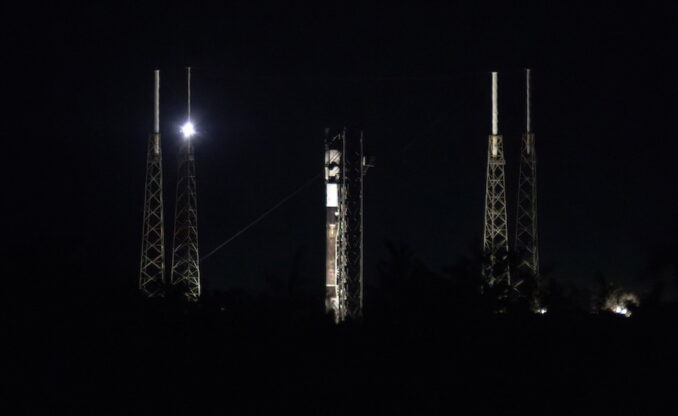
SpaceX crossed a symbolic reusability milestone with its 600th Falcon booster refly, sending 29 more Starlink V2 Mini satellites into low Earth orbit from Cape Canaveral.
Key Takeaways
SpaceX reached its 600th Falcon booster reflight with the Starlink 10-45 mission from Cape Canaveral's SLC-40, launching 29 Starlink V2 Mini satellites.
Booster B1080 flew for the 28th time; its history includes two Axiom Space crew flights, ESA's Euclid telescope and Northrop Grumman's NG-21 cargo mission.
B1080 landed on the droneship A Shortfall of Gravitas about 8.5 minutes after liftoff — the 161st landing on that vessel and SpaceX's 638th booster landing overall.
The Starlink constellation now numbers more than 10,700 spacecraft in orbit.
Earlier in the month, another Falcon 9 booster set a fleet record of 36 flights, and on the same day as B1080's launch a separate Falcon 9 sent 24 Starlink satellites up from Vandenberg, California.
Kaan Tınmaz
SpaceX quietly crossed one of its more consequential reusability milestones this week: the 600th reflight of a Falcon rocket booster. The Falcon 9 first stage tail-numbered B1080 lifted off from Space Launch Complex 40 at Cape Canaveral Space Force Station carrying the Starlink 10-45 mission, adding another 29 V2 Mini broadband satellites to a constellation that now numbers more than 10,700 spacecraft on orbit.
B1080's Track Record
The workhorse booster B1080 flew for the 28th time on this mission. Its resume includes two crew flights for Axiom Space, the European Space Agency's Euclid space telescope and Northrop Grumman's NG-21 cargo mission to the International Space Station. About 8.5 minutes after liftoff, B1080 landed on the droneship "A Shortfall of Gravitas" in the Atlantic Ocean — the 161st landing on that vessel and the 638th booster landing overall for SpaceX.
Why 600 Matters
Reuse is what actually made Falcon 9 the cheapest way to reach low Earth orbit and, by extension, made SpaceX's Starlink economics work. Every additional refly amortizes hardware cost across more revenue-generating missions and, just as importantly, exercises the fleet's turnaround process — the part that Blue Origin, ULA, Rocket Lab and Chinese competitors are still trying to catch up to.
Context: A Blistering Cadence
The milestone lands in the middle of a punishing Falcon 9 pace. Earlier this month a different booster set a new fleet record of 36 flights. SpaceX's 2026 Starlink deployment has already flown missions from both Cape Canaveral and Vandenberg on shortening cycle times, even as the company parallel-tracks Starship's next test campaign. On the same day as B1080's flight, another Falcon 9 lifted 24 Starlink satellites from California.
Reporting based on coverage from Spaceflight Now, Space.com and SpaceX broadcast.
What milestone did SpaceX reach with the Starlink 10-45 launch?
The mission marked the 600th reflight of a Falcon rocket booster, with first stage B1080 flying for its 28th time and delivering 29 Starlink V2 Mini satellites to low Earth orbit.
Which notable missions has booster B1080 flown before?
B1080's resume includes two crewed flights for Axiom Space, the launch of ESA's Euclid space telescope, and Northrop Grumman's NG-21 cargo mission to the International Space Station.
Why is the 600th booster reuse significant?
Reuse made Falcon 9 the cheapest route to low Earth orbit and underpins Starlink's economics, since each reflight spreads hardware costs across more revenue-generating missions and refines turnaround processes competitors like Blue Origin, ULA and Rocket Lab haven't matched.
How many Starlink satellites are currently in orbit?
The Starlink constellation now numbers more than 10,700 spacecraft on orbit following this launch.