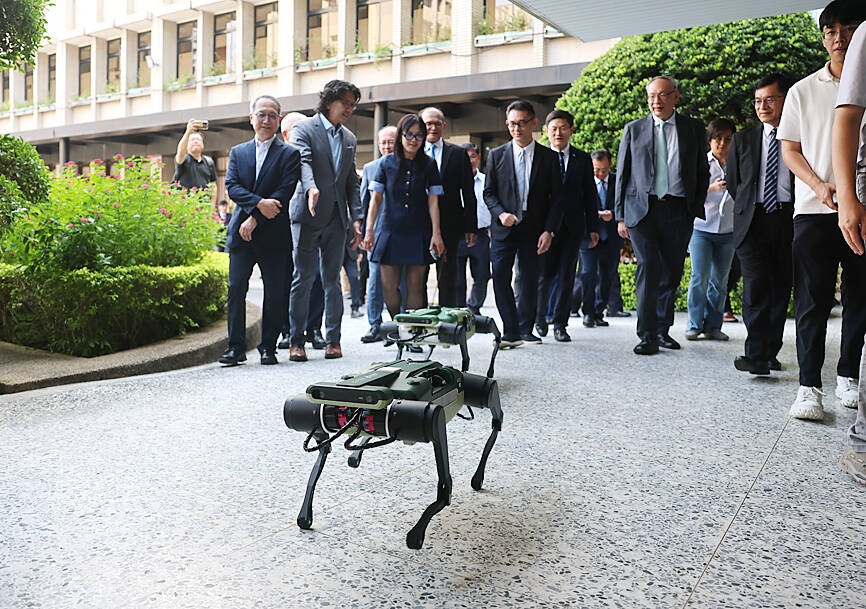
Taiwan Unveils Homegrown Quadruped Robot Dog Platform To Chase $4B Global Market
Taiwan's MOEA and ITRI have unveiled a domestic quadruped robot dog platform trained on NVIDIA Taipei-1, targeting a global robot dog market projected to top $4 billion by 2035.
Key Takeaways
Taiwan's MOEA and ITRI unveiled a domestically developed quadruped robot dog platform, targeting a global robot dog market projected to exceed $4 billion by 2035.
ITRI built the platform in 18 months to create a non-China supply chain, positioning Taiwan against U.S. leader Ghost Robotics and Switzerland's ANYbotics.
Two prototypes exist: a 20kg-payload model for firefighting and tunnel inspection in hazardous environments, and a 5kg-payload scout for autonomous navigation and collaborative transport, both built for swarm operations.
Development was accelerated by training over 4,000 virtual robot dogs in parallel on NVIDIA's Taipei-1 supercomputer and Omniverse digital twin platform.
Separately, Taiwan's National Chungshan Institute plans mass production and military procurement of its own robot dog in 2028, with combat configurations for base patrols, beach defense, and urban warfare.
Kaan Tınmaz
Taiwan's Ministry of Economic Affairs (MOEA) and the Industrial Technology Research Institute (ITRI) have unveiled a domestically developed quadruped robot dog platform, aiming to give the island a foothold in a global robot dog market the ministry projects will exceed $4 billion by 2035.
An 18-Month Sprint To A Non-China Supply Chain
ITRI built the four-legged platform in 18 months, covering autonomous components, key modules, whole-machine control, and AI software. MOEA says the initiative is meant to leverage Taiwan's information and communications technology, semiconductors, and precision machinery strengths to build a non-China supply chain against U.S. leader Ghost Robotics and Switzerland's ANYbotics.
Two Prototypes: 20kg Firefighter And 5kg Scout
The platform ships in two variants. A larger model can carry up to 20 kilograms and is aimed at firefighting and underground tunnel inspection in high-temperature, toxic, and flammable environments, having already passed capability verification. A smaller 5-kilogram-payload sibling handles autonomous navigation and collaborative transport. Both are engineered for swarm operations.
Trained On NVIDIA Taipei-1 And Omniverse
To accelerate development, ITRI used NVIDIA's Taipei-1 supercomputer and the Omniverse digital twin platform to train more than 4,000 virtual robot dogs in parallel before deploying to hardware. Solomon Technology, Compal Electronics, Inventec, Teco Electric & Machinery, Compertum Microsystems, and NexCOBOT are co-developing modules — motors, LiDAR, controllers, inertial measurement units, and system integration — on the platform.
Defense Track Adds Combat Configurations By 2028
Separately, the National Chungshan Institute of Science and Technology told lawmakers this week that its own robot dog system, which debuted last month under U.S. technology licensing, will enter mass production and military procurement in 2028 with LiDAR, reconnaissance, and combat configurations for base patrols, beach defense, and urban warfare. The push aligns with other regional robotics moves such as ITRI's earlier fire-rescue robot dog debut, Mitsubishi Motors' humanoid MoU with Highlanders, and UBTech's utility humanoid partnership in China.
Reporting based on coverage from the Taipei Times, DigiTimes, and the Ministry of Economic Affairs.
Who developed Taiwan's new quadruped robot dog platform?
The platform was developed by the Industrial Technology Research Institute (ITRI) under Taiwan's Ministry of Economic Affairs (MOEA), with partners including Solomon Technology, Compal Electronics, Inventec, Teco Electric & Machinery, Compertum Microsystems, and NexCOBOT co-developing motors, LiDAR, controllers, IMUs, and system integration.
What are the two robot dog variants and their uses?
A larger model with a 20-kilogram payload is aimed at firefighting and underground tunnel inspection in high-temperature, toxic, and flammable environments, while a smaller 5-kilogram-payload version handles autonomous navigation and collaborative transport. Both support swarm operations.
How was NVIDIA technology used in the robot dog's development?
ITRI used NVIDIA's Taipei-1 supercomputer and the Omniverse digital twin platform to train more than 4,000 virtual robot dogs in parallel before deploying the AI to physical hardware.
When will Taiwan's military robot dog enter production?
The National Chungshan Institute of Science and Technology says its robot dog system, developed under U.S. technology licensing, will enter mass production and military procurement in 2028 with LiDAR, reconnaissance, and combat configurations.