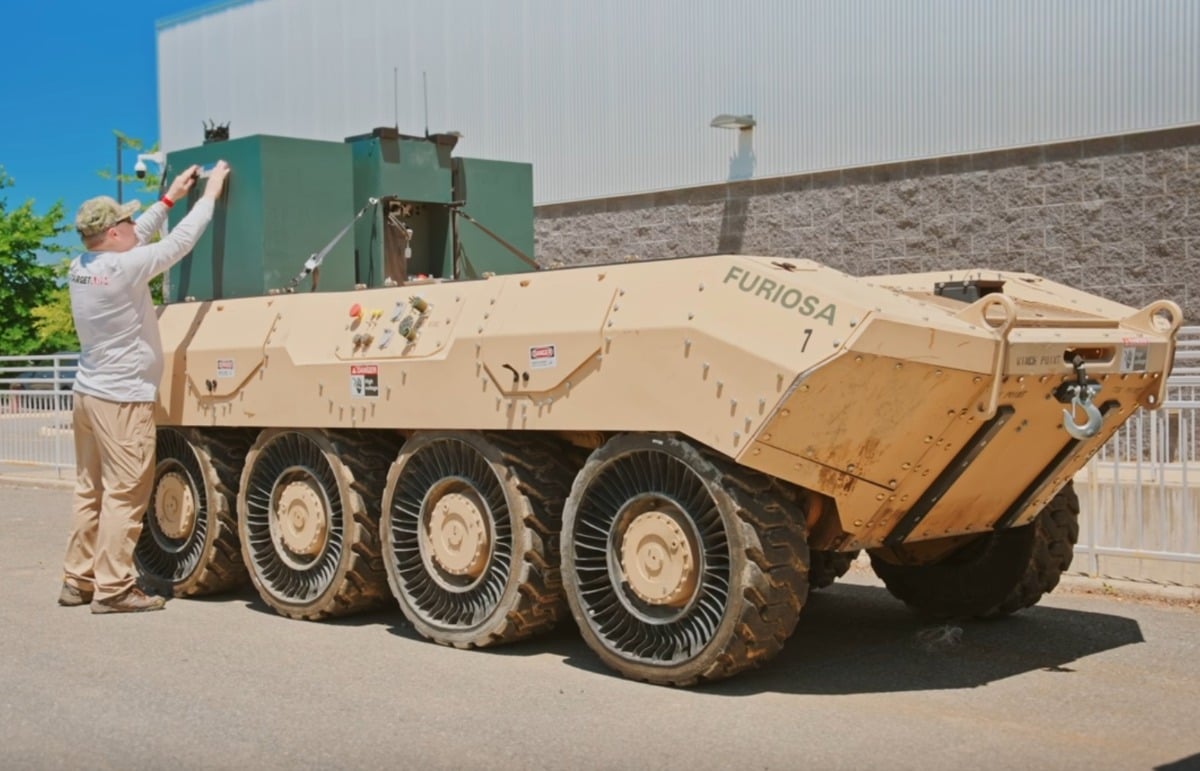
Target Arm Inc. announced on July 27, 2026 that its Ralar 2 drone launch and recovery system has been integrated with unmanned ground vehicles built by HDT Global, creating what the two companies describe as an autonomous mobile drone base. The integration pairs HDT's Hunter WOLF and larger WOLF-X wheeled UGVs — rugged robotic mules already used by militaries for logistics and reconnaissance — with Target Arm's Ralar 2 robotic arm, TRACKR sensor fusion engine, TurboFly flight controller and Maestro mission control stack.
Removing the stop-to-launch requirement
Most drones need a stationary platform to launch from and land on. A truck, ship or ground vehicle typically has to stop moving, and a human operator has to stand by, before any drone can lift off. Target Arm says Ralar 2 removes that requirement: certified drones can launch, land, recharge and relaunch from vehicles that stay in motion, on land, at sea or in the air, without a pilot at the controls. Video released alongside the announcement showed a compact tan wheeled UGV labeled FURIOSA carrying the arm through a field demonstration.

A dual-use platform
Target Arm — a Service-Disabled Veteran-Owned Small Business headquartered in New Milford, Connecticut — pitches Ralar 2 as dual-use hardware. The company lists defense operations, search and rescue, surveillance, logistics and package delivery, maritime patrols and critical infrastructure protection among its target markets. Ralar 2 magazines can house between four and 10 drones per attachment, letting a single UGV cycle multiple UAVs into service without stopping.
Where UGVs and UAVs converge
Ground robots and aerial drones have largely operated as separate systems until now, each requiring its own team, launch procedure and window of vulnerability. Collapsing that separation extends the reach of platforms like the Hunter WOLF and WOLF-X — already central to programs like the US Army's domestic robotics push — while giving smaller units drone coverage without a dedicated launcher. It follows a wider July surge in autonomous defense wins including AeroVironment's $500M counter-drone deal, Neros' $500M FPV contract and Shield AI's autonomous EW flight.
Reporting based on coverage from Target Arm, HDT Global and The Defence Blog.