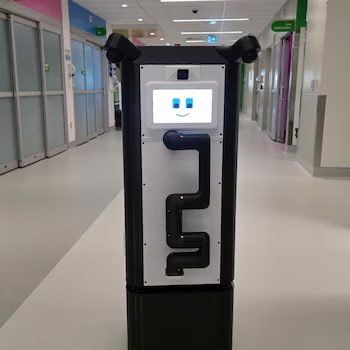
The Centre Hospitalier Universitaire de Sherbrooke has started using THEO, an autonomous robot built by local company OSCAR Robotique, to carry biological samples between care units and laboratories at its Hôpital Fleurimont and Pavillon Enfant Soleil sites. The robot navigates hallways on its own, using electronic credentials to open doors and call elevators without staff assistance, according to Infobae.
THEO carries a locked compartment, a built-in display screen and a robotic arm, and spent July through October 2026 running unloaded practice routes before it started handling real biological samples. One robot currently operates on selected routes, with OSCAR Robotique and CHUS planning to expand to four units by summer 2027. Staff still handle transport of people, fragile materials and urgent samples that need real-time human judgment.
A narrow but constant hospital job
Carrying samples between a ward and a lab sounds minor next to surgical robotics, but it is one of the most repetitive tasks in a hospital, and one where delays have direct clinical consequences. \"A hospital is an environment that never stops,\" OSCAR Robotique owner Mathias Bourgault said of the rationale for automating the run. Tying up a porter or nurse for a sample delivery pulls them away from patient-facing work, and manual courier schedules do not always match when results are actually needed.
Autonomous mobile robots have already found traction in hospital logistics elsewhere, including Diligent Robotics' Moxi units delivering supplies in US hospitals and various AMR platforms moving linens, meals and waste. THEO's niche is narrower and more clinical: biological specimens that need a documented, controlled chain of custody as much as a fast ride across the building.
Funding and what comes next
OSCAR Robotique received support from MEDTEQ+, a Quebec-based consortium that funds medical technology development, to bring THEO to this stage. The validation period through unloaded test runs before handling real samples suggests the hospital is being deliberate about reliability before scaling up. If the four-unit expansion holds by summer 2027, CHUS would have a small autonomous fleet handling a meaningful share of its internal sample logistics, freeing clinical staff from a task that adds up across a hospital running around the clock.