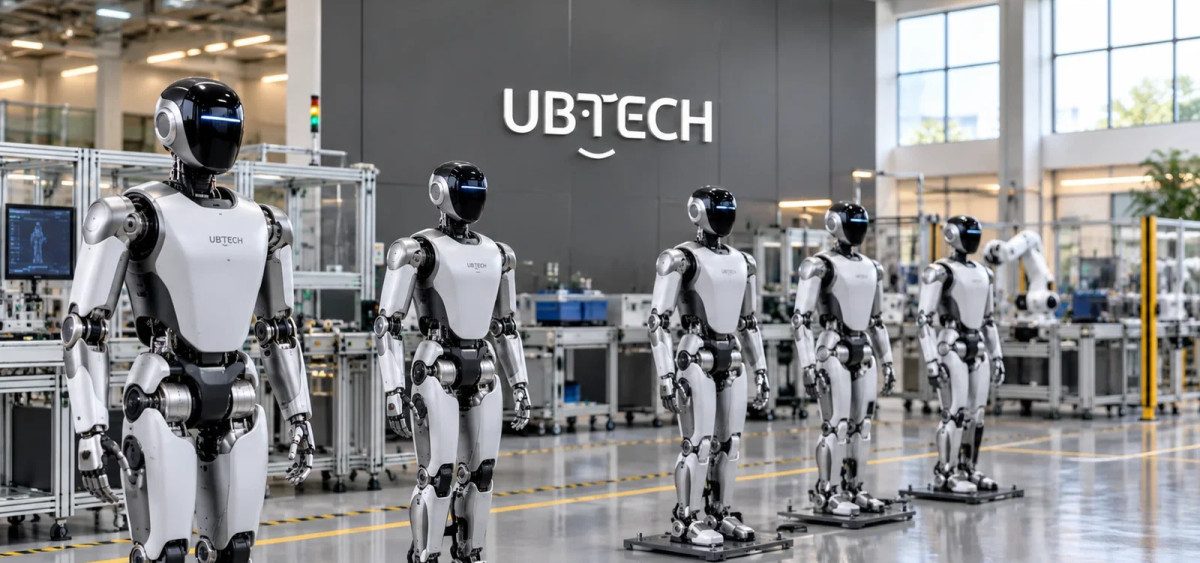
Shenzhen-based UBTECH has signed a strategic cooperation agreement with Yongda Auto, one of China's largest car dealership groups, starting with an order for 400 of UBTECH's U1 Pro humanoid robots. The deal, confirmed on November 11, 2026, is worth roughly 68 million yuan, or about $10 million, and UBTECH plans to deliver all 400 units before the end of the year.
What will 400 robots actually do inside car dealerships?
Yongda plans to station the U1 Pro robots in its showrooms for demonstrations, sales support, and customer service, according to Ad-Hoc-News. The U1 Pro is built for front-of-house work rather than heavy labor: the male configuration stands 183 centimeters tall, weighs 42 kilograms, and uses dual-eye vision plus 360-degree sensing to greet and interact with customers.
The two companies also agreed to build a joint robotics showcase center in Shanghai and to collaborate on leasing the robots to other businesses in automotive retail, treating this as the start of a recurring relationship rather than a one-off hardware sale.
Is a 400-robot order actually a big deal for UBTECH?
On its own, a $10 million contract is modest next to UBTECH's larger industrial deals, but it matters because of who's buying. Yongda Automobiles Services Holdings runs hundreds of dealerships across China, giving it the scale to turn a successful showroom pilot into a much bigger recurring order — UBTECH separately said in October it is targeting another automotive partner for 10,000 units by 2030.
UBTECH also says it can now produce 10,000 humanoid robots a year, a capacity figure that matters because China's humanoid robot makers have spent 2026 racing each other on manufacturing scale almost as much as on robot capability. UBTECH's stock rose about 4.1% the day the deal was announced.
What does the U1 Pro actually have under the hood?
The robot runs on a Rockchip RK3588 edge chip paired with a 200 TOPS AI processor and UBTECH's own UWORLD software layer, described as a "fast and slow brain" architecture. A companion model called Resonance-LM is built to recognize more than 20 distinct emotional states and hold a cross-time memory of past interactions — features aimed at reception and companionship roles rather than factory work.
Battery life is listed at two to four hours, and top speed is 5 kilometers per hour, numbers that explain why Yongda is deploying it in showrooms rather than on a factory floor, where rival humanoids from Agility Robotics and Apptronik are built for longer shifts and heavier payloads.
Why does an auto dealer want a robot instead of just hiring staff?
Yongda is betting that a humanoid robot at the showroom door draws foot traffic and social attention that a human greeter doesn't, at least while the novelty lasts. UBTECH is betting that placing robots in thousands of dealership lobbies builds a distribution and data pipeline it can later sell into other consumer-facing industries — exactly the push into the "consumer market" that both companies flagged alongside this deal.