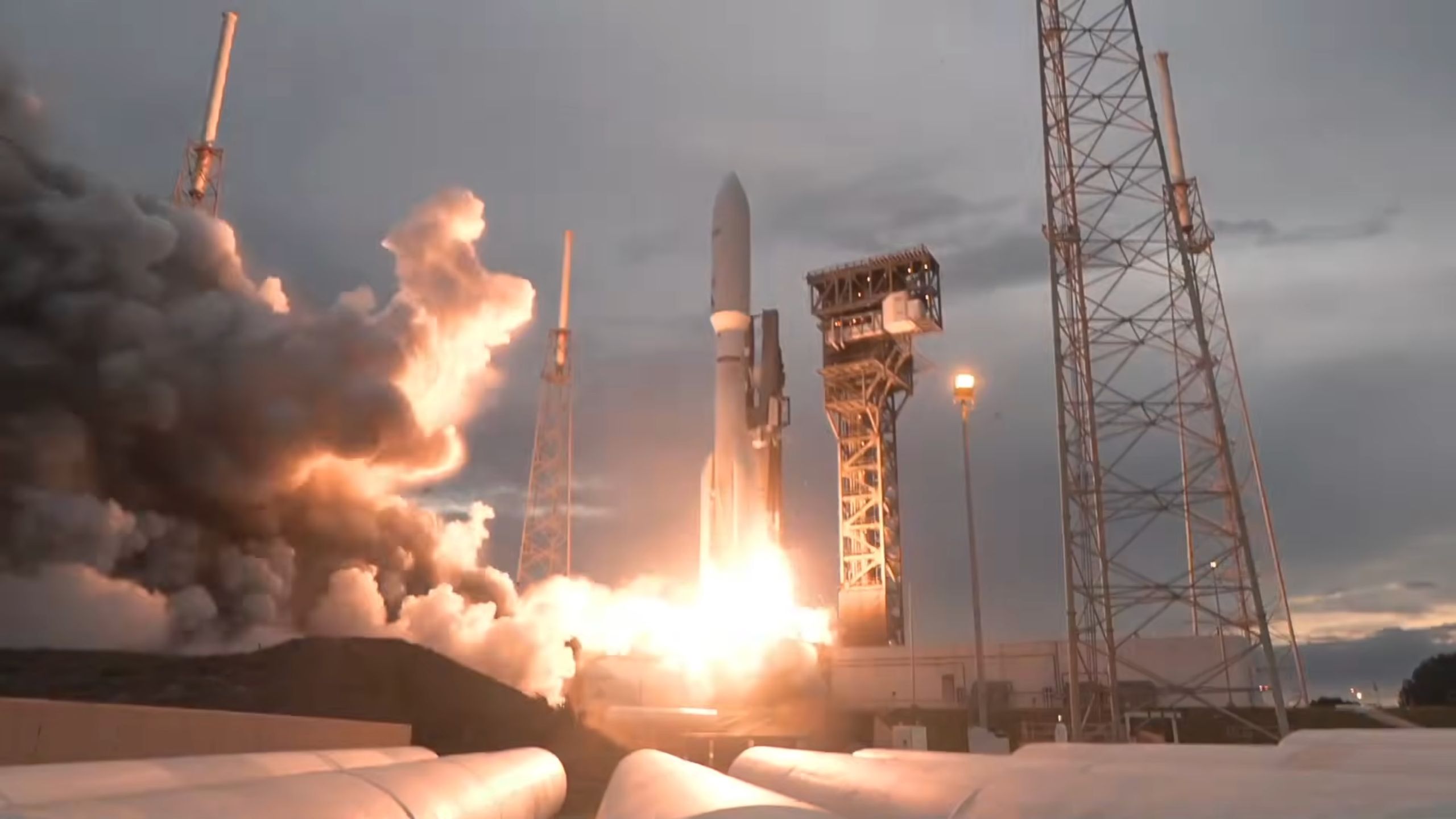
A United Launch Alliance (ULA) Atlas V rocket lifted off from Space Launch Complex-41 at Cape Canaveral Space Force Station on Friday evening, May 29, 2026, delivering 29 more Amazon Leo broadband satellites to low Earth orbit. The launch occurred at 7:53 p.m. EDT (2353 GMT).
Heaviest Atlas V Payload, Tied
The mission, designated Amazon Leo 7, was the seventh Amazon flight aboard an Atlas V and the 12th overall for Amazon's broadband megaconstellation. According to Space.com, the payload weighed roughly 18 tons, tying the heaviest payload Atlas V has ever flown for the second consecutive flight.
The rocket flew in its powerful "551" configuration: five strap-on solid rocket boosters, a single RD-180 main engine producing roughly 860,200 pounds of thrust, and a five-meter payload fairing wide enough to encapsulate the stacked Amazon satellites. The Centaur upper stage deployed the spacecraft in groups of three over about 10 minutes, with the final two satellites releasing roughly 38 minutes after liftoff.
A Constellation Racing to Catch Up
Friday's launch lifts Amazon's on-orbit fleet to 329 satellites. The company has previously said it plans to operate around 3,200 broadband spacecraft to compete with SpaceX's Starlink, which currently fields nearly 10,500. Amazon's smaller target is supported by a planned network of ground relay stations and more than 80 launches spread across ULA, SpaceX, Arianespace and Blue Origin.
Setback for Blue Origin
The Atlas V flight comes just one day after Blue Origin's New Glenn rocket exploded during a prelaunch test at Cape Canaveral, a major setback for Amazon's sister-company launch provider. Amazon Leo satellites were not aboard New Glenn during the incident, but a planned Amazon ride on the vehicle next month is now in question.
Building the In-Space Infrastructure
Broadband megaconstellations are only one part of a fast-growing low-Earth-orbit economy that increasingly includes robotic servicing and refueling missions. Earlier this week, DARPA confirmed its RSGS robotic satellite servicing demonstration is on track, while European industrial partners Schaeffler and Spire announced a sovereign-satellite tie-up. Lunar-bound robotics also advanced as Redwire delivered its MANUS lunar arm prototype to the European Space Agency.
What's Next for Amazon Leo
This was the fourth Amazon Leo mission of 2026, and the cadence is expected to accelerate as production at Amazon's Kirkland, Washington satellite factory ramps. With New Glenn temporarily offline, Amazon will rely more heavily on Atlas V and Falcon 9 launches in the near term to keep the deployment schedule on track. The constellation must reach roughly half of its authorized fleet by mid-2026 to keep its U.S. Federal Communications Commission license in good standing.
Reporting based on coverage from Space.com, Spaceflight Now and ULA.