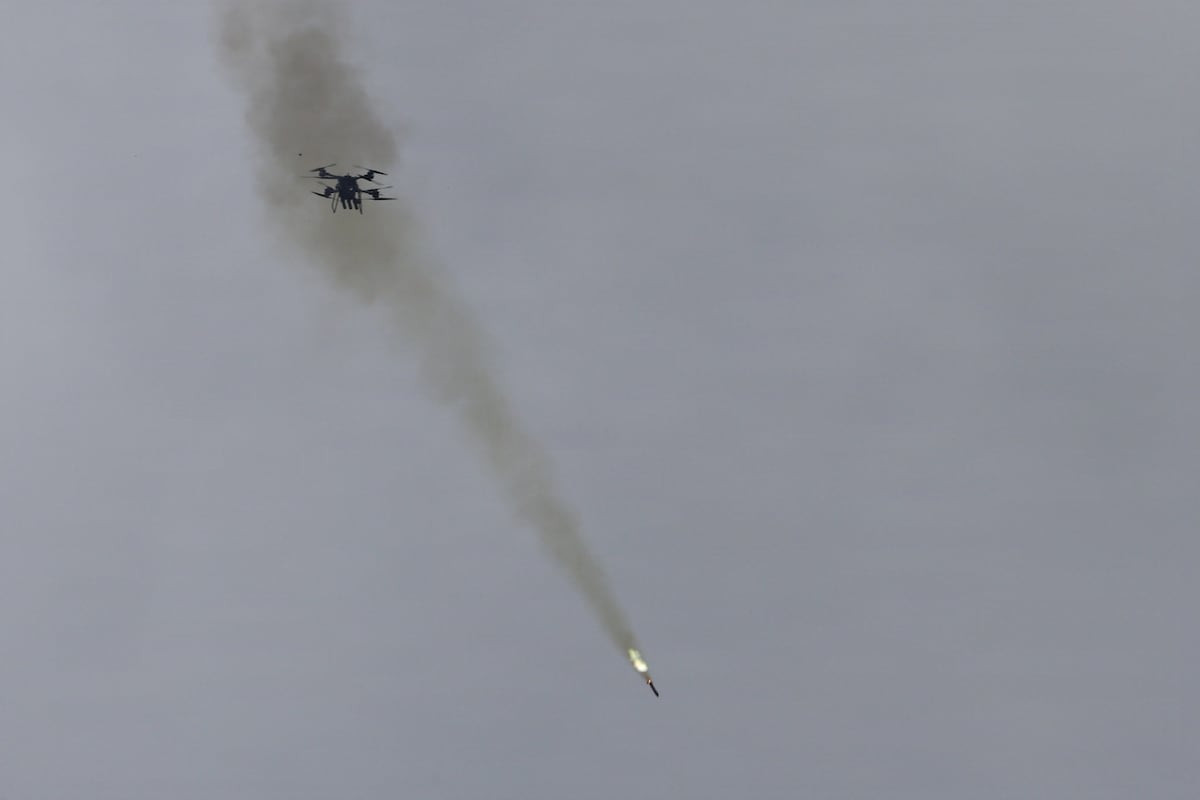
The US Army has successfully fired a 70mm Advanced Precision Kill Weapon System (APKWS) rocket from a TRV-150 cargo drone during flight testing at Fort Rucker, Alabama, transforming a logistics platform into a precision strike system. The service publicized the May 20 experiment in a release dated May 28, 2026, framing the test as part of a broader push to put more capability into the hands of lower-echelon units.
From Sky's "Pickup Truck" to Rocket Carrier
The TRV-150 Tactical Resupply Vehicle is a quadcopter-class logistics drone capable of hauling roughly 150 pounds across the battlefield. It is fielded with both the US Army and Marine Corps. For the Fort Rucker trial, defense industry partners attached a three-shot weapon system to the drone and fired 70mm rockets, the Army said.
"Normally, industry waits for requirements to come out of the government, and they meet that requirement," said Clark Dutterer, vice president of business development at Survice Engineering, which manufactures the drone. "In this case, we saw that there was something that we could prove out, a new capability, and we didn't want to wait for a requirement. We self-funded this to go ahead and do that."
Chief engineer Rob Baltrusch described the platform as the sky's "pickup truck," noting its heavy reliance on autonomous calculations. "They can literally give it a grid coordinate, wait, and it tells you if it can make it there, delivers the payload, and calculates the route," he said.
APKWS Moves From Apache to Unmanned
APKWS is currently mounted on Apache attack helicopters. Demonstrating it on a logistics drone opens a path to distributing precision strike capability across new formations, the Army said. The project has been underway since January 2025, and the system successfully fired with a single-shot launcher last May before progressing to the three-shot configuration at Fort Rucker.
Wider US Drone Acceleration
The test lands amid a Pentagon-wide drive to speed up unmanned aircraft acquisition. The Defense Department in 2025 stood up the Joint Interagency Task Force 401 to consolidate drone purchasing across the services, has launched a counter-drone marketplace for interoperable allied systems, and is building a dedicated drone testing range in Mississippi. SOCOM is eyeing the Stennis Drone Test Range for that effort, and Pentagon AI use has jumped 1,775% as the DoD orders 200,000 drones.
Adjacent autonomous-strike programs are advancing rapidly as well. Teledyne's Rogue 1 Block 2 loitering munition doubled its range to 12 miles, while DARPA is seeking swarming robot medics for the battlefield.
What's Next
The Army did not announce a formal program of record around the armed TRV-150, but the experiment validates a low-cost path to precision strike using already-fielded logistics drones. With self-funded industry investment and APKWS already in inventory, the platform could move quickly into operational evaluation if the service commits.
Reporting based on coverage from Military Times and a US Army release.