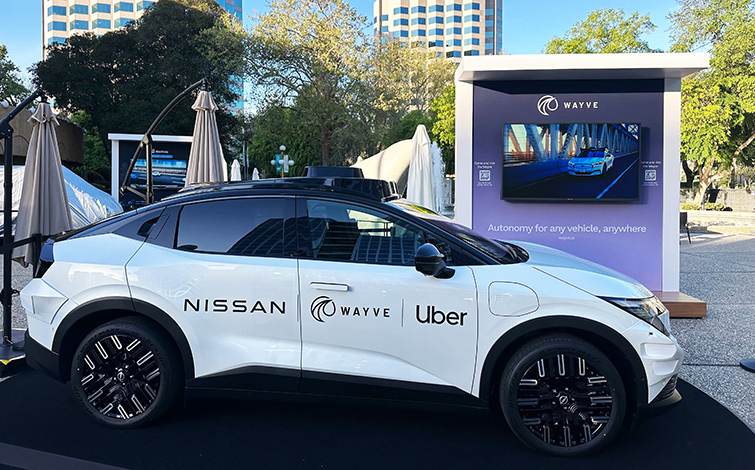
British self-driving startup Wayve has joined Nissan Motor and NVIDIA to unveil a robotaxi prototype vehicle powered by NVIDIA DRIVE Hyperion, with the platform earmarked for fleet trials run through Uber Technologies. The partnership ties together three of the most active programs in autonomy and was demoed at NVIDIA’s GTC event.
A Three-Way Stack
The prototype pairs Wayve’s end-to-end driving model with Nissan’s vehicle platform and DRIVE Hyperion’s in-cabin compute and sensor suite. Wayve, fresh off a $1.5 billion Series D, is racing to commercialise its embodied AI driving stack across multiple OEMs, while Nissan gets a credible robotaxi tile to play against Toyota and Honda. Uber, which has spent the last two years aggressively re-platforming its mobility business onto outside autonomy stacks, picks up a third major partner alongside Waymo and Nuro.

Why This Is A Step Beyond Wayve Labs
The unveiling lands less than a month after Wayve announced its Wayve Labs research unit aimed at extending embodied AI beyond cars. Where Wayve Labs is a long-horizon research bet, the Nissan-NVIDIA-Uber program is a commercial signal: Wayve is closing in on the real-world fleet deployments that justify the headline valuation.
Robotaxi Capacity Builds
The deal feeds into a year that has already seen Waymo open its 6th-gen Ojai vehicle to public riders, Uber commit $500M to Nuro, and a string of new robotaxi city launches from the Bay Area to Tokyo. Wayve and Nissan have not disclosed a commercial launch date, but the partners say trials with Uber will begin in selected European and Japanese cities.
Reporting based on coverage from Wayve, NVIDIA and Reuters.